
How to Use Vertical Space in a Small Living Room Without Making It Feel Crowded

A small living room usually needs one of three things: more storage, more visual height, or both. If you try to solve all three with the same move, the room can end up looking busy instead of bigger. The trick is to treat vertical space like a design tool, not a dumping ground.
I like to think about it in this order: first clear the lower half of the room, then choose one or two vertical features that do the most work, and finally balance everything with low-profile furniture. That sequence keeps the room feeling open while still giving you useful storage and personality.
If you are trying to decide where to begin, ask yourself one simple question: do I need the wall to hold things, or do I need the room to feel taller? Your answer changes the plan.
What to Gather Before You Start
You do not need a full makeover to use height well. A few basic tools make the job easier:
- Tape measure
- Level
- Pencil and painter’s tape
- Wall anchors or the right mounting hardware for your wall type
- Removable hooks or adhesive hanging strips for lightweight renter-friendly setups
- Floating shelves or a slim bookcase
- A full-length mirror if you want to reflect light and height
- Curtain hardware long enough to mount higher than the window frame
- A step stool for safe measuring and hanging
The tools you need depend on what you plan to hang or mount. Use proper anchors and hardware for curtains, mirrors, shelves, and art if they will be mounted to the wall. Removable hooks and adhesive strips are better for lightweight decor, not heavy storage. If you are leaning a mirror or using freestanding furniture, you may not need wall hardware at all.
Also measure before you buy anything. A shelf that looks slim online can feel bulky in a narrow room, and a mirror that is too short will not give you the vertical lift you want.
A Quick Comparison: Which Vertical Solution Fits Your Room?
| Vertical choice | Best for | Visual impact | Storage value | Renter-friendly? | Installation difficulty |
|---|---|---|---|---|---|
| Tall bookcase | Books, baskets, mixed storage | High | High | Sometimes | Medium |
| Floating shelves | Light storage, decor, remotes | Medium | Medium | Often | Medium |
| Floor-to-ceiling curtains | Making ceilings feel taller | High | Low | Yes, usually | Low to medium |
| Full-length mirror | Brightness and visual expansion | High | Low | Yes, often | Low |
| Vertical gallery wall | Personality and height | Medium | Low | Yes | Low |
| Sconces or tall floor lamps | Freeing surfaces and drawing the eye up | Medium | Low | Sometimes | Low to medium |
If you need hidden storage, shelving wins. If you need the room to feel taller fast, curtains and a mirror usually do more than a shelf full of decor. If you want both function and style, combine one storage feature with one height feature.
Step 1: Clear the Lower Half of the Room
The lower half of a small living room sets the tone. When the floor area is crowded with chunky baskets, oversized side tables, and too many small objects, the room feels shorter and tighter before you even look up.
Aim for cleaner sightlines from the floor to about waist height. That does not mean empty. It means intentional. Swap a bulky media cabinet for a slimmer console if you can. Replace two small storage pieces with one taller one. Keep the area around the sofa legs visible if possible, because seeing more floor usually makes the room feel less cramped.
A good test: stand in the doorway and look at the first three feet of the room. If your eye hits clutter before it reaches the walls, the room needs editing before it needs decorating.
Step 2: Choose One or Two Vertical Focal Points
A small living room rarely benefits from five different tall features competing for attention. One strong vertical move is usually enough. Two can work well if they serve different jobs.
Here is the easiest decision framework:
- Choose storage if the room has too many items with no home.
- Choose height if the room feels squat, dark, or visually compressed.
- Choose both if the room has storage problems and low ceilings.
For example, a slim bookcase plus floor-to-ceiling curtains can work beautifully because one handles function and the other changes the room’s proportions. A tall mirror plus a vertical gallery wall can also work if the wall is large enough and the pieces are spaced generously.
What usually fails is stacking too many vertical ideas on one wall. A tall shelf, several art pieces, a mirror, and a lamp all in one zone can feel top-heavy. Give each feature breathing room.
Step 3: Use Wall-Mounted Storage and Floating Shelves to Save Floor Space
Wall-mounted storage is one of the clearest ways to reclaim square footage in a small living room. It lifts everyday items off the floor and keeps the room from feeling packed at ground level.
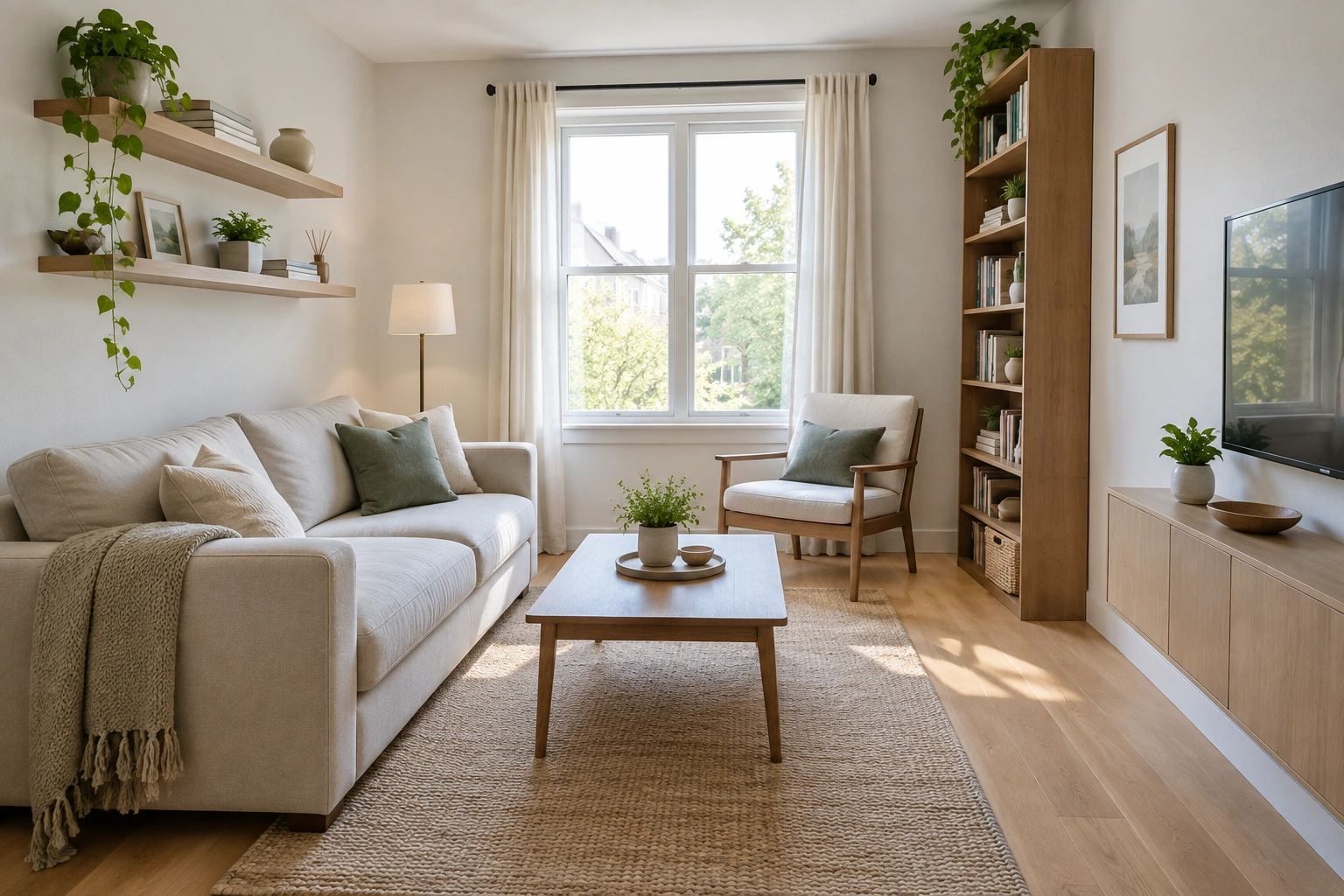
Floating shelves work best when they have a job, not just a decorative purpose. Think books you actually use, a basket for remotes, or a small row of baskets for charging cords and controllers. If a shelf is only there to look full, it tends to collect clutter fast.
A few placement rules help:
- Put shelves where you naturally need storage, such as beside the sofa or above a low console.
- Leave enough wall space around them so they do not look crowded.
- Use fewer, longer shelves instead of many tiny ones when possible.
- Keep the heaviest items on lower shelves for a calmer visual balance.
- Place shelves above furniture with enough clearance that the setup feels intentional, not cramped.
For renters, adhesive shelves and removable hooks can work for very light items, but check the product limits carefully and avoid overloading them. If you need real weight support, a freestanding tall bookcase is often safer and easier than trying to force a wall-mounted solution into a wall that is not suited for it. For heavier storage needs, choose a bookcase, cabinet, or leaning storage piece instead of relying on adhesive hardware.
Step 4: Hang Curtains High to Raise the Eye Line
Curtains are one of the fastest ways to make a small living room feel taller because they change where the eye stops. If the rod sits right above the window frame, the room can feel visually chopped. When the rod is placed higher—ideally several inches above the trim, or as high as the wall allows—the window reads as taller, and so does the room.
If you can, let the curtains fall all the way to the floor. That long line is what creates the lift. Short curtains usually interrupt the effect.
A few practical tips:
- Mount the rod about 4 to 6 inches above the window frame in many typical rooms, or higher if the wall and ceiling height allow it.
- Extend the rod beyond the window on both sides so the panels can stack off the glass.
- Choose simple panels without heavy ruffles or thick patterns if the room is already busy.
- In very low-ceiling rooms or on short walls, keep the rod as high as possible without making the panels awkwardly short; a clean, floor-length panel is still the goal.
- If the window is very close to the ceiling, use a mount that follows the wall line cleanly instead of forcing extra height that looks cramped.
The trade-off is length. Floor-to-ceiling curtains may need custom sizing or a little hemming, but the visual payoff is usually worth it. If you are renting and cannot alter the wall much, a tension rod inside a deep window frame can still help, though it will not create the same height effect as a higher mount.
Step 5: Add Tall Mirrors and Vertical Art to Stretch the Room Visually
Mirrors and artwork do different jobs. A mirror reflects light and gives the room more visual depth. Artwork adds personality and can reinforce height, but it does not usually open the room in the same way.
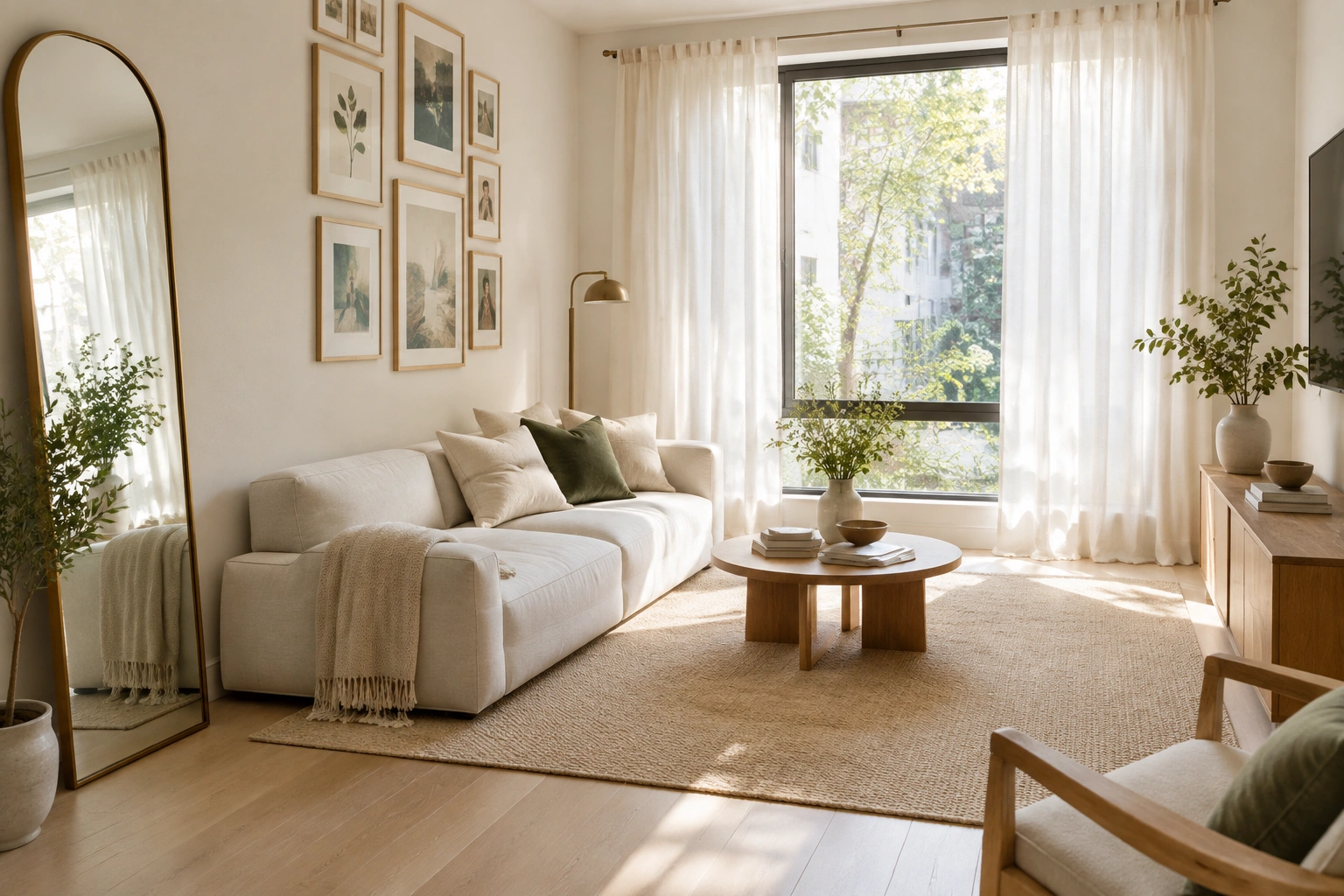
If your living room is dim or narrow, a tall mirror often does more for the space than several small prints. Place it where it can catch light from a window or brighten a darker corner. A full-length mirror leaning against the wall can also work well if you want a relaxed look and do not want to drill. If you hang it, center it over a console or place it on a wall that reflects a window or another bright area rather than a blank corner.
Artwork is still valuable, especially when it is arranged vertically. A stack of two or three pieces in a column can guide the eye upward more cleanly than a wide, scattered arrangement. If you are building a gallery wall, keep the spacing consistent and leave enough blank wall around it so the display does not swallow the room.
Placement matters here, too. As a general rule, hang art so the center of the piece sits around eye level, and keep it about 6 to 8 inches above a sofa or console when it is placed over furniture. A vertical piece above a sofa should usually be sized to feel connected to the furniture below it, not lost above it. As a rough guide, art over a sofa often looks balanced when it is about two-thirds the width of the sofa or a grouped arrangement that fills a similar span.
The rule I use: one large vertical statement usually reads calmer than many small pieces. If you love smaller art, group it tightly and keep the surrounding wall simple.
Step 6: Use Lighting That Emphasizes Height
Lighting can quietly change how tall a room feels. Table lamps take up surface space. Tall floor lamps and wall sconces pull the eye upward and free room for other essentials.
Sconces are especially useful when you need your side tables back. They can replace a lamp that crowds a narrow surface and help the wall feel more intentional. Tall floor lamps work well near a reading chair or beside a sofa, where their height adds a vertical line without taking over the room.
If you want the room to feel taller, avoid lighting that sits too low and spreads horizontally in every direction. A mix of one upward-reaching lamp and one wall-mounted light source often feels lighter than several small lamps scattered around the room.
Step 7: Balance Tall Elements With Low-Profile Furniture
Vertical design works best when the furniture below it stays visually quiet. A low-profile sofa, slim coffee table, and simple side tables let the eye move upward instead of getting stuck on bulky shapes.
This is where scale matters. A tall bookcase beside a heavy, overstuffed sofa can make the room feel compressed. The same bookcase next to a sofa with visible legs and a lower back can feel balanced and airy.
If you are choosing between two pieces, ask which one has the lighter silhouette. Exposed legs, narrow arms, and flatter surfaces usually help a small room breathe. You do not need every piece to be tiny. You just want the lower half of the room to feel less visually dense than the upper half.
Common Mistakes That Make a Small Living Room Feel Shorter
The biggest mistake is overfilling every vertical surface. A small room can handle height, but it cannot always handle visual noise.
Watch for these problems:
- Too many small art pieces scattered across the wall
- Curtains hung at window height instead of higher on the wall
- Shelves packed edge to edge with decor
- Bulky furniture blocking the lower half of the room
- Dark, heavy finishes used on every tall piece
- Tall items placed on every wall, which makes the room feel boxed in
Negative space matters. A blank area next to a tall shelf can make the shelf look more intentional, not less decorated.
Renter-Friendly and Budget-Friendly Vertical Ideas
If you cannot drill or do not want to spend much, you still have options.
Try these first:
- Removable hooks for lightweight art or organizers
- Adhesive shelves for very light items only
- Tension rods for curtains or temporary fabric panels
- A freestanding bookcase that reaches upward without wall mounting
- A tall mirror that leans instead of hangs
- Over-the-door organizers in nearby closets if your living room storage spills over into entry storage
For heavier storage needs, skip adhesive solutions and use freestanding furniture instead. A tall bookcase, narrow cabinet, or leaning shelf can give you vertical storage without asking too much of the wall.
For budget setups, I would prioritize one tall mirror or one freestanding shelf before buying lots of small decor. One strong vertical piece usually does more than several inexpensive items that do not work together.
Troubleshooting: What to Do If the Room Still Feels Crowded
If the room still feels heavy after you add vertical elements, look at balance first.
If the top half feels busy, remove one or two items from shelves or walls. If the room feels tall but awkward, add a lower, simpler piece to anchor it—like a low coffee table or a plain bench-style console. If the wall coverage feels too broad, consolidate into one vertical feature instead of several separate ones.
Another common issue is mismatched scale. A tiny mirror above a large sofa can look lost. A huge shelf over a narrow chair can overpower the corner. Recheck the width of the furniture below before choosing what goes above it.
When in doubt, leave more empty wall than you think you need. In a small living room, restraint usually reads as calm and spacious.
Practical Room Setups That Actually Work
A narrow rental living room might use a tall mirror near the window, a ceiling-mounted curtain rod, and one slim floor lamp beside the sofa. That combination adds height without drilling much or using much floor space.
A tiny apartment living room with storage issues might do better with one tall bookcase on a single wall, a low-profile sofa, and a small floating shelf for daily items. The key is keeping the opposite wall mostly open so the room does not feel boxed in.
A very small space that needs both personality and function can pair a vertical gallery wall above the sofa with a wall shelf underneath for remotes and books. That gives you display plus storage, but still keeps the lower half of the room relatively clear.
If you want a room to feel taller, do not think only about what to add. Think about what to lift, what to slim down, and what to leave open. That is usually what makes a small living room feel brighter, calmer, and much easier to live in.
When to Call a Space Planner
If your living room has unusual angles, very low ceilings, multiple doorways, or built-ins that already crowd the walls, a space planner can help you avoid expensive mistakes. That is especially useful when you want to install heavy shelving or make the room work for both storage and seating.
A professional can also help if you have already tried the usual fixes and the room still feels awkward. Sometimes the issue is not decoration—it is scale, traffic flow, or wall placement.
FAQs
How high should I hang shelves in a small living room?
Place shelves where they are useful, but keep them visually light. In practice, that usually means leaving clear space below and avoiding the temptation to fill every inch of wall. If a shelf sits too low, it can make the room feel compressed.
Are tall bookcases better than low storage in a small room?
Tall bookcases are better when you need storage and want to use wall height. Low storage is better when you want the room to feel open and horizontal. Many small living rooms do best with one tall piece and a few low, simple pieces.
Do mirrors or artwork make a small room feel bigger?
Mirrors usually do more for openness because they reflect light and depth. Artwork adds personality and can help direct the eye upward, but it does not expand the room visually in the same way.
Can renters use vertical storage without damaging walls?
Yes. Freestanding bookcases, leaning mirrors, removable hooks, and some adhesive products can work well. Just keep weight limits in mind and avoid putting heavy items on anything that is not designed to hold them.
What is the fastest change I can make?
Hang curtains higher, clear clutter from the lower half of the room, and add one tall mirror or one slim vertical shelf. Those changes usually have the biggest visual payoff for the least effort.