
Where to Place a TV in a Small Living Room: A Practical Layout Guide

If your small living room feels like a puzzle, the TV placement question is usually the piece that changes everything. The fastest rule I use is this: put the TV where it has the clearest view from your main seating, the least glare, and the fewest traffic conflicts. In a small room, that usually means the largest uninterrupted wall, but not if that wall creates a bad walk path or puts the screen opposite a bright window.
A TV should support the room, not take over the room. When the placement is thoughtful, the sofa feels easier to position, the room reads as more open, and the screen stops fighting with doors, windows, and furniture. Mounting can help with that by freeing up floor space and making the layout feel lighter. If you want a simple starting point, that is the one I would trust first.
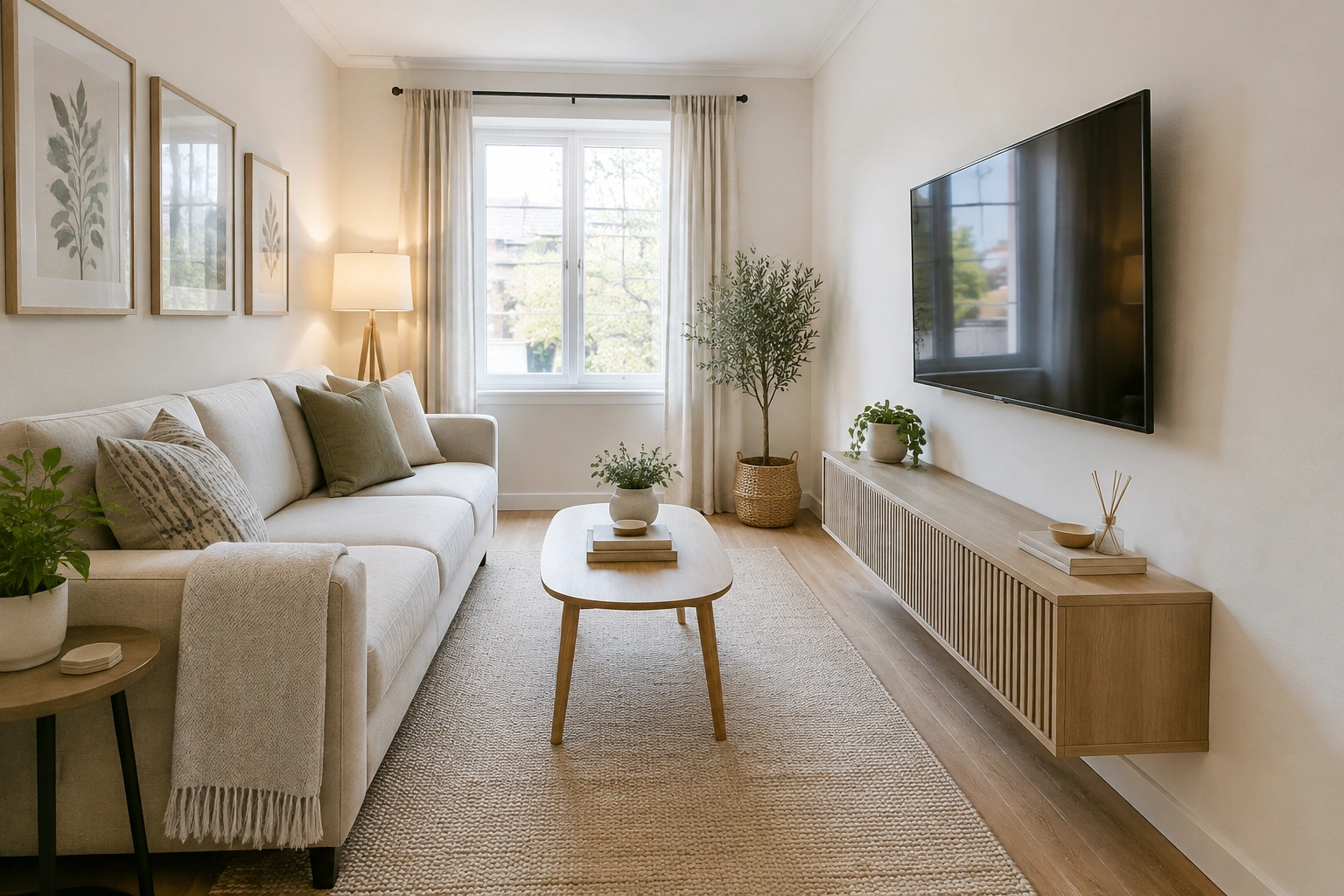
Quick Answer: The Best TV Spot in a Small Living Room
Choose the spot that gives you three things at once:
- A straight or slightly angled view from the main seating area
- Enough wall space so the TV does not feel squeezed
- A clear path so people can still move through the room
If one wall checks all three boxes, that is usually the winner. If no wall does, prioritize the seating view first, then glare, then circulation. A TV that is easy to watch but awkward to live with is still a bad placement.
Here is the simplest decision rule I use when helping people plan a compact room:
- Use the main wall if it is mostly clear and does not cut off walking space.
- Use a narrow console or media shelf if you rent, move often, or want flexibility.
- Use a corner only when a straight wall setup would block the room or the seating area.
That order matters because a small room can look crowded fast. The best placement is not always the most centered one. It is the one that lets the room function without forcing every other piece of furniture to work around the screen.
What to Measure Before You Choose a TV Location
Before you commit to a wall, measure the room like a layout problem, not a decorating guess.
Measure these five things:
- The room dimensions
- The sofa-to-TV distance
- The clear width of each wall
- Window and door locations
- The TV size you plan to use
Those measurements tell you whether the TV belongs on the wall, on a stand, or in a corner. They also help you avoid the most common small-room mistake: choosing a spot first and discovering later that the sofa has nowhere sensible to go.
A useful habit is to tape the TV’s footprint on the wall and the console footprint on the floor before buying anything. That quick mockup shows whether the setup will feel balanced or oversized. In a small living room, a few inches can change the whole feel of the room.
If the room has an alcove, that can also be a strong option. An alcove can create a cozy nook for a TV, but it still needs enough clearance around the screen so the setup does not feel boxed in.
Wall Mount, TV Stand, or Corner Placement: Which Works Best?
Here is the practical comparison I use when a small room has limited options.
| Placement option | Best for | Trade-off | Watch out for |
|---|---|---|---|
| Wall mount | Tiny rooms, renters who want floor space, clean lines | Less flexible once installed | Mounting too high, glare, visible cords |
| TV stand or media console | Renters, people who rearrange often, rooms with storage needs | Uses more floor space | Bulky furniture that overwhelms the room |
| Corner placement | Square rooms, awkward layouts, rooms with broken wall space | Can feel less polished if forced | Off-angle viewing, awkward furniture arrangement |
Wall-mounted TV: best when floor space is tight
A wall mount is usually the cleanest solution when the room is small and the wall is usable. It frees floor area, which helps the room feel less crowded. It also makes it easier to pair the TV with a smaller console or floating shelf instead of a full-size media cabinet.
The trade-off is permanence. If you rent, move often, or are not sure where the room will end up, mounting can feel like a bigger commitment.
TV on a stand: best when flexibility matters
A stand or narrow media console works well when you want storage or when drilling into walls is not realistic. It is often the better choice for renters because it avoids wall damage and gives you more freedom to shift the layout later.
The downside is visual weight. In a small room, a deep, chunky console can eat up the space faster than the TV itself. If you go this route, choose the narrowest piece that still supports the screen safely and leaves room to walk around it.
Corner placement: best when the room shape is awkward
Corner placement is not the first choice for most rooms, but it can save a layout when the main walls are interrupted by doors, windows, or a fireplace. It can also work in a square room where centering the TV on one wall would make the whole room feel boxed in.
The trade-off is angle. A corner TV usually asks the seating to pivot a little, which can be perfectly fine for a casual living room but less ideal if you want a more formal, straight-on arrangement.
How to Pick the Best Wall or Focal Point
The best wall is usually the one that gives the TV the clearest view without stealing the room’s circulation.
Look for a wall that is:
- long enough to hold the screen without crowding it
- visible from the main seating area
- not interrupted by a doorway where people constantly pass
- less exposed to direct glare
- able to support the rest of the furniture around it
If the biggest wall also has a window, fireplace, or entry door, do not force the TV there just because it is the largest surface. In a small room, the wall that looks ideal on paper can become a problem once furniture is added.
A good test is to stand in the doorway and ask: where does my eye naturally go first? If the TV would fight that first impression instead of working with it, consider another wall or a more flexible setup.
You may also need a secondary focal point. That matters in small rooms with fireplaces, built-ins, or strong architectural features. If the fireplace is already the visual anchor, the TV may work better on a side wall so the room does not feel like it has two competing centers.
Direct answer: longest wall, opposite the sofa, or corner? In most small living rooms, the best choice is the longest wall only if it also works with the sofa and traffic flow. If the sofa already has a natural opposite wall with enough space and limited glare, that is often the cleanest setup. Use a corner only when the straight-wall options create tighter walkways or awkward furniture placement. In other words, choose the wall that gives the best viewing angle and circulation together, not the one that is simply biggest.
Step-by-Step: Place the TV in a Small Living Room
1. Identify the main seating position
Decide where people will actually sit most often. That matters more than the room’s geometric center. A TV should face the place where you lounge, not a spot that only looks balanced in a floor plan.
2. Mark the largest usable wall
Look for the wall with the fewest interruptions. Tape out the TV size on that wall so you can see how much visual space it will take.
3. Check glare before you commit
If sunlight hits the screen during the day, move the TV or plan for window treatments.
4. Decide between mounting and a stand
Use a mount if you want to save floor space and keep the room visually lighter. Use a stand if you need storage, flexibility, or a renter-friendly setup.
5. Place the seating with circulation in mind
Leave enough room for people to walk without brushing the coffee table, console, or chair arms. In a small room, a layout that preserves a clean path usually feels better than one that centers everything too tightly.
6. Check the viewing angle from the sofa
Sit where you usually sit and look at the taped TV outline. If you feel like you are turning your neck or craning upward, adjust the height or move the screen.
How High Should the TV Be Mounted or Set?
The most comfortable TV height is generally close to seated eye level. That is the simplest way to reduce awkward neck positioning. Several furniture and design sources point to this same idea, including a general rule that the center of the screen is about 42 inches above the floor and another rule of thumb that the bottom third of the screen should align with eye level.
Those are guidelines, not laws. What matters most is how the screen feels when you are actually sitting in the room.
A helpful check:
– Sit in your normal spot.
– Look straight ahead.
– The center of the screen should feel close to your natural line of sight.
If the TV is mounted too high, the room may look dramatic in photos but uncomfortable in real life. That is especially true in small living rooms, where the seating is often closer and the angle is more noticeable.
How Far Should You Sit From the TV in a Small Room?
In a compact room, a simple rule of thumb is to place the sofa about 1.5 to 2.5 times the diagonal size of the TV away from the screen. For example, a 50-inch TV usually feels comfortable at roughly 6 to 10 feet, depending on the room and how you watch.
That is not a strict formula, but it gives you a practical target. If your room is tight, use the room’s usable depth to decide whether a smaller or larger screen makes more sense:
- Smaller screen if the sofa must sit very close to the TV or the wall is narrow
- Larger screen if the seating is farther back and the wall can handle the scale
- Middle-size screen if you want the safest choice for a compact room
The goal is to avoid a screen that feels either tiny from the sofa or overwhelming from a short distance. If you are torn between two sizes, the room usually looks calmer with the smaller option.
How to Handle Windows, Glare, Fireplaces, and Odd Layouts
When a window faces the TV
A TV opposite a bright window can work, but glare often becomes the deciding factor. If that wall is otherwise ideal, think about shades, curtains, or a slight angle before giving up on it. The screen should stay readable at the times you actually use the room.
When the fireplace is the main feature
A fireplace often becomes the natural focal point, but that does not mean the TV has to sit above it. If the mantel is too high or the fireplace wall is already visually busy, placing the TV on a separate wall often creates a calmer layout. That choice can also make seating easier because the sofa does not have to face upward.
When the room is narrow
In a narrow living room, a wall mount or slim console usually beats a deep media cabinet. Keep the furniture lines simple and avoid bulky pieces that shrink the walkway.
When the wall is off-center
Off-center walls are common in apartments and older homes. Instead of forcing perfect symmetry, align the TV with the seating and let the furniture do the balancing. A floating shelf or compact console can help the setup feel intentional even when the architecture is not.
Space-Saving Furniture and Cord Management Tips
The TV area should feel tidy enough that the screen reads as part of the room, not the whole room.
A few practical choices help:
- Use a narrow media console instead of a deep cabinet when floor space is tight.
- Choose a floating shelf if you only need a small landing spot for a streaming box or a few decor pieces.
- Pick compact seating so the room does not feel overfilled around the screen.
- Run cords through a wall cover or along a baseboard so the setup looks finished.
If the TV is mounted, cord management becomes even more important because the wall around it is so visible. If the TV sits on a console, keep the surface edited. One or two objects is enough. A crowded console makes the whole room feel smaller.
For a broader look at how you can keep a room feeling calm and intentional, you can also browse Everyday Elsie’s home decor ideas and room inspiration.
Common Mistakes to Avoid When Placing a TV in a Small Living Room
The biggest mistakes are usually the simplest ones.
- Mounting the TV too high. This is the fastest way to create neck strain and make the room feel less relaxed.
- Ignoring glare. A great wall can become a bad wall the moment sunlight hits the screen.
- Using oversized furniture. A deep console or oversized sofa can crowd the room before the TV even goes up.
- Blocking walkways. If people have to squeeze around the coffee table, the layout is too tight.
- Leaving cords exposed. In a small room, visible cords read as clutter very quickly.
A small living room usually looks best when the TV is part of a simple, balanced arrangement rather than the only thing the room is built around.
Practical Layout Examples for Small Living Rooms
Narrow apartment living room
Mount the TV on the longest clear wall and place the sofa directly opposite if the walkway still works. Keep the console slim and the side furniture minimal. Leave at least one clear path from the entry to the seating area so the room does not feel like a tunnel.
Rental with no drilling
Use a low media console and let the TV sit on top instead of mounting it. This keeps the layout flexible and avoids wall damage. If you want an even easier renter-friendly option, use a freestanding TV stand or rolling TV cart so you can reposition the screen without drilling holes. Choose a console or stand with clean lines rather than a bulky storage unit so the room still feels open.
Room with a fireplace as the main feature
If the fireplace already anchors the room, place the TV on a separate side wall. That often gives the seating a better angle and prevents the room from feeling visually crowded around one wall. Keep the sofa aimed toward the TV wall or slightly between the fireplace and the screen if the room needs a dual-purpose layout.
Tiny square room
A corner setup can preserve the center of the room and keep the furniture from feeling boxed in. This works especially well when the room needs a path through it and a straight-on wall placement would eat too much space. Use a small sofa or loveseat and avoid oversized armchairs so the circulation stays open.
Awkward room with an off-center doorway
Use the wall that gives the best sightline from the sofa, even if it is not perfectly centered. A floating shelf or narrow console can make the TV area feel intentional and help the rest of the furniture stay open. Keep the seating slightly angled if that improves the path from the doorway to the rest of the room.
Troubleshooting: If the TV Placement Still Feels Off
If the room still feels awkward after you place the TV, check these three things first:
- The height: If you are looking up, lower the screen.
- The angle: If the sofa is off to one side, angle the TV slightly toward the main seat.
- The furniture scale: If the room feels crowded, reduce the size or depth of the console and coffee table before changing the TV again.
Sometimes the TV is not the real problem. The issue is the furniture around it. A room can feel much better after you swap a bulky table for a slimmer one or move the sofa a few inches to improve the path through the room.
If you are stuck between two workable layouts, choose the one that keeps the room easier to live in every day. That is usually the one that wins over time.
When to Consult a Space Planner
If your room has multiple fixed obstacles — for example, a fireplace, two doors, a window wall, and limited seating options — a space planner can help you avoid trial-and-error rearranging. That is especially useful when you want the room to function as both a lounge and a daily gathering space, or when you are unsure whether a mount, console, or corner setup will work best.
A good plan should make the room feel calm, not crowded. When the TV placement supports that, the whole space gets easier to use.
For more inspiration on creating a room that feels welcoming and balanced, visit About Everyday Elsie.
FAQ
What is the best place for a TV in a small living room?
The best place is usually the wall that gives you the clearest view from the main sofa, the least glare, and the easiest circulation. In many small rooms, that is the longest uninterrupted wall.
Should a TV go on the longest wall or opposite the sofa?
Use the longest wall if it also works with the sofa and walking path. If the sofa already has a natural opposite wall with enough space, that can be the better choice. Do not force the longest wall if it creates glare or blocks movement.
Is corner TV placement good for small living rooms?
Yes, sometimes. Corner placement can help in square rooms or awkward layouts, but it usually works best when straight-wall placement would crowd the room or interrupt the walkway.
What is a good TV distance for a small room?
A practical rule of thumb is about 1.5 to 2.5 times the TV’s diagonal size. For a 50-inch TV, that is roughly 6 to 10 feet.
What should renters do if they cannot drill into the wall?
Use a TV stand, a freestanding TV console, or a rolling TV cart. Those options keep the setup flexible and avoid wall damage.
How can I reduce glare on my TV?
Place the TV away from direct window light when possible, or use curtains, blinds, or a slight angle to reduce reflections.
How high should the TV be mounted?
Aim for a height close to seated eye level. The exact spot depends on your sofa height and how far away you sit.
How do I make a small TV area look less cluttered?
Use a slim console, keep decor minimal, and hide cords early. A lighter-looking setup usually makes the whole room feel larger.