
Can You Put a Sofa in Front of a Window? A Practical Layout Guide

Yes — you can put a sofa in front of a window, and in many rooms it works beautifully. There is no universal design-rule or feng shui ban on it; the right choice depends on light, access, and balance. The catch is that it should look intentional and still let the room function well. If the window is your main source of daylight, if the sill hides a radiator, or if your curtains need wide clearance, the placement needs a little more planning.
I like to think of this layout as a trade-off, not a rule. You may lose some open window visibility, but you can gain a better seating arrangement, a stronger focal point, or a layout that finally makes a difficult room feel usable.
A sofa in front of a window tends to work best when the window is tall, the room is bright, and the sofa is not so bulky that it swallows the opening. It tends to cause problems when the window needs to be opened often, when a heater sits below it, or when the sofa blocks the light that makes the room feel calm and open.
If you’re planning a small room, this can be one of the smartest ways to use space. If you want more help with tight layouts, you may also like my guide to where to put a sofa in a small living room.
When a Sofa in Front of a Window Works Well
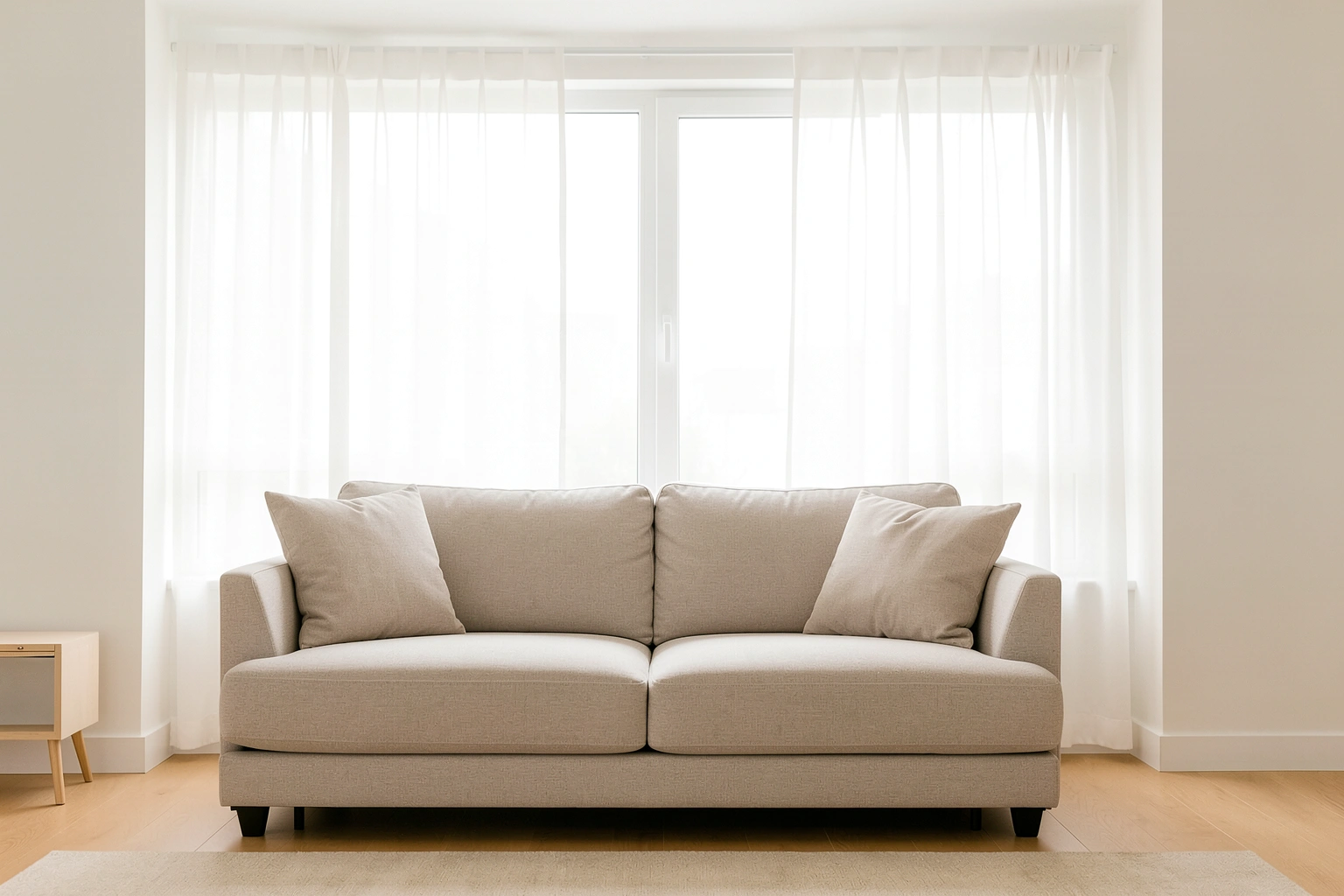
This layout is usually most successful in rooms that already get plenty of daylight. If the window is large, the sofa can sit in front of it without making the room feel dark. In fact, the window can become a soft backdrop instead of the main event.
It also works well when the sofa is low enough to keep the upper part of the window visually open. A low-back sofa, a slim track-arm sofa, or a piece with visible legs usually feels lighter than a deep, boxy silhouette.
Here are the situations where I’d consider it a strong option:
- The room is narrow and the window wall is the most practical place for seating.
- The window is a picture window or tall opening that still leaves plenty of light above the sofa.
- The sofa is not the only seating in the room, so the layout can stay balanced.
- You want the room to feel centered and anchored rather than pushed to one side.
- The window treatment is simple enough that the sofa won’t interfere with it.
The short version: if the sofa helps the room function better without stealing too much light or access, it is usually a good choice. If the window is the room’s main feature and the sofa would cover too much of it, a solid wall may be the better place for the couch.
When It Causes Problems
The biggest issue is usually not style — it’s function. A sofa can block the window enough to make the room feel closed in, especially if the window is already small or low. If the back of the sofa rises high into the glass area, the room may lose the open, breezy feeling you were hoping to keep.
Another common problem is window access. If you can’t easily open the sash, pull the shades, or clean the glass, the layout may become annoying very quickly. That’s especially true in rentals, where you may not be able to change the window treatment or hardware.
Watch for these trouble spots:
- The sofa blocks a radiator, floor vent, or baseboard heater.
- The curtain stack needs more side clearance than the sofa allows.
- The window is the room’s main source of daylight.
- The sofa back is tall enough to cut the window visually in half.
- The room depends on cross-ventilation, and the sofa makes opening the window awkward.
There’s also a design trade-off: a sofa in front of a window can either look polished or accidental. If it sits too close, floats at the wrong height, or interrupts the curtain line, it often reads as “we had nowhere else to put it.” The fix is usually careful spacing and a few visual anchors, not a different sofa altogether.
What to Measure Before You Move the Sofa
Before you drag anything across the floor, measure the room in three places: the window opening, the sofa itself, and the space around the window treatment.
You’ll want:
- Sofa width, depth, and back height
- Window width and sill height
- Curtain rod projection or blind depth
- Distance from the wall to any radiator, vent, or heater
- Space needed for the window to open and for curtains to move freely
A tape measure is enough for most rooms. If you want to be precise, use painter’s tape on the floor to mark the sofa footprint before moving it. That makes it much easier to see whether the room still feels open from the doorway and whether the seating line blocks too much of the glass.
If the window has a radiator or heater below it, measure from the wall to the front edge of that unit too. You are not just planning for the sofa back — you are planning for airflow, heat, and access.
How to Place a Sofa in Front of a Window Step by Step
1. Decide what the window needs to do
Ask one simple question: does this window need to stay fully usable, or mainly stay visually open? If it’s a bedroom-style window that rarely opens, you have more freedom. If it’s a living room window you use daily, treat access as a priority.
2. Check the sofa height against the window
A lower sofa usually preserves the window better. If the back rises close to the sill or into the middle of the glass, the layout can feel heavy. In that case, either pull the sofa forward a bit or choose a lower-profile piece.
3. Mark the footprint with tape
Lay painter’s tape on the floor where the sofa would sit. Step back from the room entrance, the main seating angle, and the opposite wall. This is the fastest way to judge whether the sofa feels centered, too dominant, or nicely balanced.
4. Test the curtain or blind movement
Open and close the window treatment before committing. If the curtain panels bunch behind the sofa or the blinds hit the back cushion, the placement needs adjustment. This is where many otherwise good layouts fail.
5. Leave room for maintenance
You should still be able to clean the glass, reach the latch, and adjust the treatment without climbing over the sofa. If the window gets dusty fast or the sill is used for plants, the gap matters more than it does in a decorative-only window.
6. Fine-tune the distance
Move the sofa slightly forward if it’s crowding heat or fabric movement. Move it slightly back if the room needs more floor space and the treatment still works. Small shifts can change the whole feel of the room.
As a practical rule of thumb, aim for about 6 to 12 inches between the back of the sofa and the window wall when the window treatment is simple and there is no heat source below the sill. If you have full-height curtains with a thick stack, or you need easy access to the window, leave more space. If there is a radiator, baseboard heater, or vent, keep the sofa far enough away to avoid blocking airflow; in many rooms that means more than a few inches, not less.
How Much Space to Leave Between the Sofa and the Window
There is no single perfect distance for every room, because curtains, blinds, and heaters all change the answer. Instead of chasing a universal number, use the function of the window as your guide.
Leave enough room so that:
- Curtains can hang straight and move without catching on the sofa
- Blinds can raise and lower without rubbing the back cushions
- The window can open without hitting the furniture
- Air can move if there’s a vent, radiator, or heater below the sill
- You can still clean the glass and reach the hardware
If you have full-length curtains, the rod and panels matter as much as the sofa. Some rooms need more side clearance simply because the curtain stack is wide when open. With blinds or shades, the challenge is often depth rather than width, which can make a closer placement more realistic. If you use inside-mount shades, the sofa can usually sit a little closer than it could with bulky drapery, as long as the back does not interfere with the sill or hardware.
If there’s a radiator or baseboard heater under the window, don’t press the sofa against it. Heat buildup is bad for comfort and not great for upholstery, and it can make the room feel stuffy. In that case, a little breathing room is usually worth the extra floor space.
How to Keep the Room Bright and the Sofa Protected
The best way to preserve light is often to keep the sofa low and the window treatment light. Sheer curtains, woven shades, or a layered setup with a lighter daytime treatment can soften the window without making it feel shut down.
If your room gets strong sun, think about fabric fade before you think about styling. Direct sunlight can be rough on upholstery over time, especially on darker or more saturated colors. A UV-filtering shade or window film can help reduce that exposure without forcing you to close the room off completely.
Here’s the practical balance I aim for:
- Use lighter fabrics near strong sun.
- Choose a sofa with a back that doesn’t block the whole window.
- Keep the treatment easy to open so daylight is still usable.
- Avoid letting the sofa sit directly in a hot sunbeam for long stretches if you can help it.
How to Make the Layout Look Intentional
A sofa in front of a window looks best when the rest of the room supports the choice. You want the placement to feel planned, not like a last-minute compromise.
Centered vs. offset placement
Centered placement creates a formal, symmetrical look. It works best when the window is the room’s main feature and the sofa is the anchor. Offset placement is more forgiving when the window is off-center, when a radiator is underneath, or when the room needs a better walking path.
Low-back vs. high-back sofas
A low-back sofa usually wins if you want to keep the window feeling open. A high-back sofa can still work, but it tends to read as a stronger visual wall. If the room already feels tight, that heavier look can be too much.
Use the back of the sofa on purpose
If the sofa back faces the room, give it a finished edge. A slim console table behind it can help the placement feel deliberate, especially in a larger room or open-plan space. Keep the styling light: a lamp, a shallow bowl, or one stack of books is enough. You want the back of the sofa to look like part of the composition, not an afterthought.
If curtains or drapery are visible behind the sofa, make sure the fabric can fall cleanly without bunching on the cushions. A little extra clearance can make the whole arrangement feel more polished because the window treatment still reads as part of the design instead of getting trapped behind the furniture. With blinds or shades, keep the hardware easy to reach and avoid letting the sofa block the pull chain, lift cord, or lower rail.
Balance the opposite side
If the sofa blocks part of the window, balance the room with a chair, plant, or side table on the opposite side. That visual counterweight helps the whole arrangement feel calm.
Common Mistakes to Avoid
The easiest mistake is pushing the sofa too close to the glass. That usually creates problems with curtains, cleaning, and airflow all at once.
The next mistake is choosing a sofa that is too tall. A tall back in front of a low window can make the whole wall feel chopped up. If you already own the sofa, try moving it forward a little or pairing it with a lighter treatment so the window still reads as a feature.
Other common missteps:
- Forgetting to check whether the window has a radiator or vent
- Blocking the curtain stack so panels can’t open fully
- Centering the sofa automatically, even when the room wants an offset layout
- Ignoring how much daylight the room loses once the sofa is in place
- Leaving the back of the sofa visually unfinished in a room that needs a more polished look
Troubleshooting Common Window-and-Sofa Problems
The sofa is too tall
If the back overwhelms the window, you have three options: move it farther from the wall, switch to a lower-profile sofa, or shift the layout so the sofa is no longer the main piece on that wall.
The window needs to open often
If you use the window for fresh air, keep the sofa far enough away to reach the hardware easily. In a rental, that convenience matters more than symmetry.
There’s a radiator under the sill
Do not block it. Shift the sofa forward or use a different seating piece. A loveseat or two chairs may fit better because they can be placed with more breathing room.
The curtains need more clearance
If drapery is the issue, switch to a slimmer treatment like blinds or shades, or move the sofa slightly forward. Heavy curtain stacks and deep sofas rarely get along in tight rooms.
The room feels dim
If the sofa is making the room feel darker, lighten the window treatment, lower the sofa profile, or move the seating to another wall. Sometimes the best solution is simply choosing a different wall and letting the window stay visually open.
Better Alternatives If the Layout Does Not Work
If the sofa-in-front-of-window setup keeps fighting the room, don’t force it. A loveseat can preserve more light and still give you a seating anchor. Two chairs can work even better if you want the window to stay open and airy.
A floating layout is another strong option. Pulling the sofa away from the wall and placing a slim console behind it can solve circulation issues while leaving the window fully visible. In small rectangular rooms, that can sometimes outperform a window-wall arrangement entirely.
If your room has another solid wall, that may be the easiest and most comfortable answer. A sofa against a blank wall usually gives you simpler curtain access, less sun exposure, and fewer compromises. That does not make it more stylish — just easier.
For a broader look at tight-room planning, my guide to a functional tiny living room layout can help you compare the options before you commit.
Practical Room Examples
In a small apartment living room with one bright window, I’d usually try a low-back sofa placed in front of the window, sheer curtains, and a simple side table to keep the room feeling light. That setup works when the room needs the sofa to do the heavy lifting and there isn’t a better wall for it.
In a room with a radiator under the window, I’d be more cautious. The sofa may need to sit forward enough to keep heat moving freely, which can change the whole layout. In that case, a loveseat or a pair of smaller chairs may give you more flexibility than one large couch.
In a larger living room with strong afternoon sun, I’d think about protection first. A UV-filtering shade or film can help, and an offset sofa placement may prevent the window from feeling completely blocked. If the sofa is still too visually heavy, a console table behind it can make the arrangement feel finished instead of crowded.
FAQ
Is it okay to put a sofa in front of a window?
Yes. There is no universal rule against it. The main question is whether the placement still works for light, access, and room balance.
How far should a sofa be from a window?
A practical starting point is about 6 to 12 inches in simple setups, with more space needed for curtains, blinds, or any radiator or vent below the sill. Measure the treatment, not just the wall.
Can a sofa go in front of curtains?
Yes, but the curtain stack needs room to open and drape properly. If the sofa crowds the panels, the layout can feel awkward fast.
Is it bad feng shui to put a sofa in front of a window?
Not automatically. The better question is whether the sofa blocks too much light, access, or visual balance. If the room still feels open and functional, the placement can work.
What if there is a radiator under the window?
Do not block it. Leave enough room for airflow or choose a different seating arrangement, such as a loveseat or chairs.
Bottom Line
You can absolutely put a sofa in front of a window, but the layout works best when you treat the window as a working part of the room, not just a backdrop. Measure the treatment, respect any heat source below the sill, and choose a sofa that preserves as much light as possible. If the room still feels cramped after that, the better answer may be a loveseat, chairs, or a floating layout instead.