
Do Mirrors Make a Small Living Room Look Bigger? A Practical Guide

Yes — mirrors can make a small living room look bigger, but only when they reflect the right thing and are sized to the room.
That’s the part people often miss. A mirror is not magic on its own. In a tight living room, it works by bouncing light, extending the view, and creating the sense that the wall continues beyond where it actually ends. If the reflection shows a bright window, a pretty lamp, or an open sightline, the room usually feels airier. If it shows clutter, a dark corner, or a busy TV wall, the effect can backfire.
So if you’re wondering whether a mirror is worth trying, my answer is: yes, often — but treat it like a layout tool, not just wall decor.
How a Mirror Creates the Feeling of More Space
A mirror helps a small room in two main ways.
First, it reflects light. That matters because brighter rooms tend to feel more open than dim ones. If daylight or a lamp bounces deeper into the room, the corners stop feeling so heavy.
Second, it adds visual depth. Your eye sees the reflected room as extra space, even though the square footage has not changed. That’s why a mirror can make a wall feel less final and a seating area feel less boxed in.
The size and placement matter more than the fact that it’s a mirror. A tiny decorative mirror can look nice, but it usually won’t change the overall feeling of the room much. A larger mirror, especially one with a simple frame, tends to create a stronger sense of openness because it gives your eye more reflected surface to read as space.
Before You Hang One: What to Check First
Before you buy or move a mirror, look at the room honestly.
If the living room is already crowded with furniture, baskets, cords, and stacked decor, the mirror will reflect that clutter. In that case, the room may still feel busy even if it’s brighter. A mirror can amplify what’s already there.
Check these four things first:
- Light: Is there a window, glass door, or bright lamp worth reflecting?
- View: What will the mirror actually show?
- Wall space: Do you have one clear wall that can handle a larger piece?
- Furniture scale: Will the mirror look balanced above the sofa, console, or chair?
A mirror works best when it has room to breathe. If you’re trying to squeeze it into a wall that already has shelves, art, and a clock, the result can feel crowded instead of restful.
If your living room also feels visually off-balance, you may want to pair a mirror with better furniture proportions and layout fixes. I have a separate guide on how to make a small living room feel balanced without making it feel crowded, which helps when the room needs more than one solution.
Best Mirror Placement for a Small Living Room
The best placement is the one that reflects something worth seeing.
For a small living room, that usually means choosing a wall that can bounce daylight or open up a view without repeating clutter. A mirror above a sofa facing a window is a strong option if the reflection stays bright and calm. If the sofa wall is too busy, a floor mirror on a narrow wall beside a bright opening can also work well because it adds height without taking over the whole wall.
Put it where it can bounce natural light
If you have a window, placing a mirror across from it or at an angle to it can help spread daylight farther into the room. That usually makes the space feel less boxed in, especially in apartments with only one main window.
You do not need the mirror to face the window perfectly head-on. Sometimes a slight angle works better because it catches light without showing a direct glare.
Reflect an open or attractive view
A mirror is most useful when it reflects:
- a window with daylight
- a lamp that gives off warm light
- a plant
- a clean architectural line
- a pretty piece of furniture
A mirror is least useful when it reflects:
- a TV screen
- a pile of toys
- a dark hallway
- a cluttered bookshelf
- an awkward blank corner
That’s the biggest decision rule: place the mirror where the reflection improves the room, not where it repeats the problem.
Use it to anchor a major furniture zone
A large mirror above a sofa or coffee table can create a strong focal point and make the seating area feel more intentional.
That said, the mirror should not overpower the sofa. If the sofa is modest in scale, a mirror that is too massive can make the wall feel top-heavy.
Step-by-Step: How to Place a Mirror for a Bigger-Looking Room
Here’s the process I use when I’m helping a small room feel less cramped.
1. Pick the wall with the best reflection
Stand in the room and look at the walls from the main seating spot. Choose the wall that can reflect the brightest or prettiest view. If one wall faces a window and another faces a dark TV corner, the window wall usually wins.
2. Decide what you want the mirror to do
Choose one primary goal:
- More light: place it near or opposite a window
- More height: use a vertical mirror
- More width: use a horizontal mirror
- Less visual heaviness: choose a simple frame or frameless style
Trying to do all four at once often leads to a mirror that feels decorative but not especially effective.
3. Match the mirror to the furniture below it
A common mistake is hanging a mirror that is too small above a sofa or console. The wall then looks chopped up instead of expanded.
As a general visual rule, the mirror should feel connected to the furniture under it. If the sofa is wide, a narrow mirror may look accidental. If the furniture is small, an oversized mirror can feel bossy.
4. Hang it at a comfortable viewing height
The center of the mirror should usually sit near eye level for the room’s main use. In a living room, that often means not too high. If you hang it too far up the wall, it stops reflecting the room in a useful way and starts acting like a floating object.
5. Step back and check the reflection
Before you commit, look at what the mirror shows from the seating area and from the doorway. If it reflects clutter or glare, adjust the angle or choose a different wall.
What Size Mirror Works Best?
In a small living room, larger usually works better than smaller — within reason.
A large mirror gives the eye a bigger field of reflected space, which can make the room feel more open. A cluster of small mirrors can be pretty, but it often reads as decoration rather than expansion. If your goal is to make the room feel larger, one strong mirror usually beats several tiny ones.
Here’s the trade-off:
- Large mirror: stronger spatial effect, cleaner look, better focal point
- Small mirror: easier to fit, softer decorative touch, but less impact on openness
If you have one wall that feels empty and heavy, a larger mirror often solves the problem more effectively than a gallery of small pieces.
A good test: if the mirror looks undersized next to your sofa, console, or chair, it probably is.
Wall Mirror vs Floor Mirror: Which Is Better?
Both can work. The better choice depends on your room and your rental situation.
| Option | Best for | Trade-off |
|---|---|---|
| Wall mirror | Saving floor space, creating a clean look, tighter rooms | Needs secure mounting or hardware |
| Floor mirror | Adding height, renter-friendly setups, flexible placement | Needs stable leaning space and a safe spot |
Wall-mounted mirrors
A wall mirror is the cleaner option in most small living rooms because it doesn’t take up floor area. That’s especially helpful if the room already has a sofa, chair, coffee table, and media unit competing for space.
Wall mirrors also tend to feel more intentional. They can act like built-in decor instead of an extra object leaning around.
Floor mirrors
A floor mirror can be a good move if you want a relaxed, airy look and you do not want to put holes in the wall. It can also make a narrow room feel taller because of its vertical scale.

The downside is practical: it needs enough clear floor space to lean safely, and it should not be placed where it can get bumped by traffic or furniture. If you have pets or kids, secure placement matters even more.
Round vs Rectangular Mirrors: Which Shape Makes the Room Feel Larger?
Shape changes the mood of the room, even if the mirror size stays the same.
Rectangular mirrors
Rectangular mirrors usually create the strongest sense of scale. They echo the shape of walls, sofas, and consoles, which can make the room feel more orderly and expansive. They’re especially useful if you want to emphasize width above a sofa or height in a narrow room.
Round mirrors
Round mirrors soften sharp lines. That can be lovely in a room full of boxy furniture, but they usually feel more decorative than space-expanding. I like them when the room already has enough structure and needs a little visual easing.
Which one should you choose?
If your main goal is to make the room feel larger, rectangular usually has the edge. If your main goal is to soften the room and make it feel less rigid, round can be the better fit.
A round mirror above a console can look elegant. A rectangular mirror above a sofa usually feels more grounded and often does more for the sense of space.
Practical Examples of Good Mirror Placement
Here are a few setups that tend to work well in real living rooms.
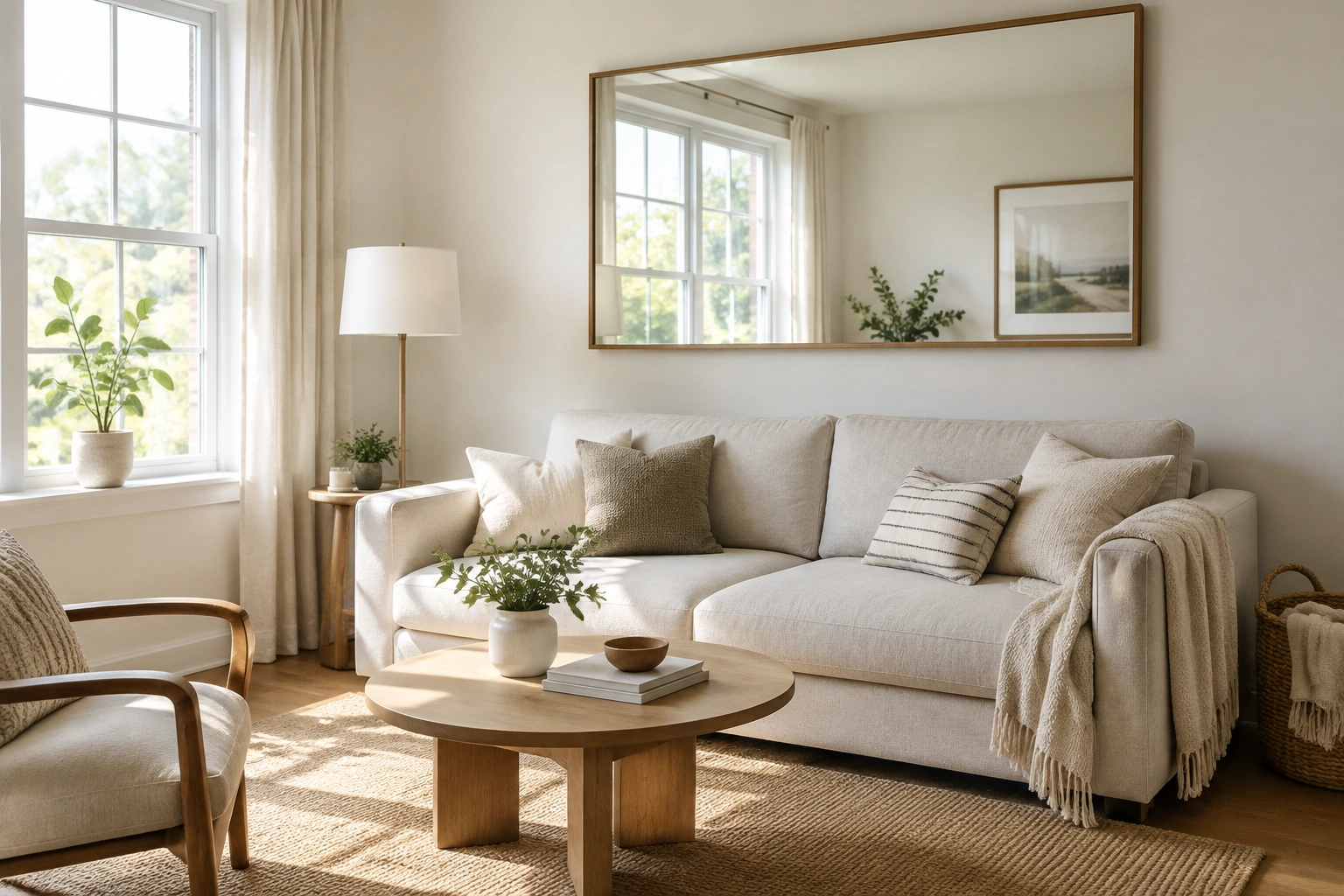
Above a sofa, reflecting a window
This is one of the strongest mirror placements for a small living room. The sofa gives the mirror a clear visual anchor, and the reflected window helps spread daylight through the room.
Opposite a window in a narrow room
If the room feels dark and tunnel-like, placing a mirror opposite the window can help the light travel farther. This is especially useful in apartments where the living room has only one bright side.
Above a console table in a compact apartment
A round mirror or a slim rectangular mirror above a console can make the entry side of the living room feel more polished without taking up much space.
Leaning floor mirror in a narrow wall section
If one wall feels too empty and the room needs height, a floor mirror can fill the vertical space without adding visual bulk. This works best when the mirror reflects something calm, not a cluttered shelf.
Common Mistakes That Make the Room Feel Worse
Mirrors can help a small room, but they can also make it feel more chaotic if they’re used carelessly.
Reflecting clutter
This is the biggest mistake. If the mirror shows cords, stacked mail, or a crowded shelf, the room feels busier, not larger.
Using too many small mirrors
A wall full of tiny mirrors can look fragmented. Instead of opening the room, it chops the wall into pieces.
Choosing an ornate frame that feels heavy
Thick, dark, or overly decorative frames can weigh down a small room. That may work in a larger, more formal space, but in a compact living room it can feel visually dense.
Hanging it too high
A mirror that sits too high loses usefulness. It stops reflecting the room at a helpful angle and starts feeling disconnected from the furniture.
Creating glare
If direct sun or a strong lamp hits the mirror at the wrong angle, the glare can be distracting. In a small room, that distraction matters more because there’s less visual space to absorb it.
Troubleshooting: If the Mirror Still Makes the Room Feel Small
If you’ve hung the mirror and the room still feels cramped, check the reflection first.
If it reflects a dark wall, move it. If it reflects clutter, simplify the view. If the room still feels flat, add a light source nearby so the mirror has something brighter to bounce.
You can also improve the effect by reducing visual noise around it. A mirror works harder when the surrounding wall is calm. That means fewer competing frames, fewer shelves, and fewer objects crowding the same area.
If the mirror is large but the room still feels tight, the issue may be furniture arrangement rather than decor. In that case, the mirror is only doing half the job.
How Mirrors Fit Into a Bigger Small-Space Strategy
Mirrors are best used as part of a larger plan.
They work well with:
- better lighting: place a lamp so the mirror can bounce it deeper into the room, or use a mirror near a window to spread daylight
- smaller-scale furniture: keep the sofa, chair, and coffee table visually light so the reflection shows open space instead of bulky pieces
- clear surfaces: a mirror near a tidy console or uncluttered wall feels more effective than one beside stacked decor
- simple wall styling: one strong mirror can do more than a busy gallery wall, especially when the seating area is already crowded
In a cramped living room, the mirror should support the layout, not compete with it. A floor lamp beside a mirror can brighten a dark corner, while a mirror above a sofa can visually widen the main seating zone. If the room has a narrow path, keep the mirror on a wall that doesn’t fight with traffic flow.
If you want the room to feel bigger, don’t ask the mirror to fix clutter, poor lighting, and awkward furniture all by itself. Let it support a cleaner layout.
Simple Rules to Remember
If you want the shortest version, keep these rules in mind:
- Use a mirror to reflect light or something attractive.
- Choose one larger mirror over several tiny ones when space is tight.
- Keep the frame simple if the room already feels busy.
- Put the mirror where it helps the room, not where it repeats clutter.
- Match the mirror’s size to the sofa, console, or wall it lives on.
- Wall mirrors save floor space; floor mirrors add height and flexibility.
- Rectangular mirrors usually feel more expansive; round mirrors feel softer.
Used well, a mirror can make a small living room feel brighter, calmer, and a little more open. Used carelessly, it just gives the clutter a second audience. The trick is choosing what the mirror sees.
FAQ
Where should I put a mirror in a small living room?
Place it where it reflects daylight, a lamp, or an open view. A mirror above a sofa facing a window or on a narrow wall beside a bright opening are both strong options.
Is it better to put a mirror opposite a window or beside one?
Either can work. Opposite a window usually spreads the most light, while beside a window can be better if direct glare is a problem or if the opposite wall shows clutter.
What size mirror works best in a small living room?
A larger mirror usually has more impact than a small one, as long as it still fits the wall and furniture scale. If it looks too tiny above a sofa or console, it probably won’t do much for the room’s sense of space.
Should I choose a wall mirror or a floor mirror?
Choose a wall mirror if you want to save floor space. Choose a floor mirror if you want a flexible, renter-friendly option and have a safe wall section with enough room to lean it.
Do round mirrors make a room look bigger?
Round mirrors can help a room feel lighter, but rectangular mirrors usually create a stronger sense of openness because they cover more wall area and echo the room’s lines more clearly.
What should a mirror reflect in a small living room?
Ideally, it should reflect a window, a plant, a lamp, or another calm, attractive part of the room. Avoid placing it where it mainly shows clutter, a TV, or a dark corner.
Can a mirror make a small living room feel worse?
Yes. If it reflects mess, creates glare, or is too small for the wall, it can make the room feel busier instead of bigger.
How do I use a mirror with other small-space design choices?
Pair it with better lighting, lighter furniture, and simpler wall decor. The mirror works best when the rest of the room is already visually edited down.