
How to Make a Low-Ceiling Living Room Look Taller: A Practical Styling Guide

If your living room feels a little too close overhead, the goal is not to fight the ceiling. It’s to make the room read taller through color, proportion, and clean vertical lines.
The fastest wins are usually these:

- Hang curtains higher than the window frame and let them fall to the floor.
- Choose low-profile furniture so more wall shows above the furniture line.
- Keep wall, trim, and ceiling colors soft and fairly close in tone.
- Use lighting that preserves headroom, like flush-mount or semi-flush fixtures.
- Add one or two mirrors where they reflect light, not clutter.
Those changes do not physically raise the ceiling, but they can change how the room feels the moment you walk in. In a low-ceiling space, every visual break matters. Short curtains, bulky furniture, and lots of small decor pieces all chop the room into smaller pieces. The trick is to reduce those interruptions and let the eye travel upward.
What You Need Before You Start
You do not need a full redesign to get this right. A few simple tools will help you make better decisions before buying anything.
Gather these basics:
- Tape measure
- Painter’s tape or removable wall dots
- Curtain rod and brackets, or a ceiling track if appropriate for your space
- Curtain panels long enough to reach the floor
- Paint samples if you plan to repaint
- A mirror or two, sized for the wall you want to use
- A floor lamp, flush-mount, or semi-flush light if the current fixture feels heavy
- A phone camera, which helps you see the room as a whole instead of piece by piece
If you are renting, check what you can change safely before drilling. For mirrors, curtain hardware, and lighting, the wall type and mounting method matter. Heavier pieces need proper anchors, and ceiling-mounted hardware should only be used if the installation is suitable for your ceiling and the fixture’s weight.
Step 1: Choose Colors That Lift the Room
Color is one of the simplest ways to make a low ceiling feel less dominant. Light colors reflect more light and usually feel airier. That does not mean every low-ceiling room must be white, but it does mean deep, heavy color is harder to use well when the ceiling is already low.
Light vs. dark: what changes the feeling of height
A light wall color gives the eye less resistance. It creates a softer transition between wall and ceiling, which helps the room feel open. Dark walls can be beautiful, but in a low-ceiling living room they often make the ceiling line more obvious unless the room has strong natural light and careful balance elsewhere.
A useful rule: if the room already feels tight, keep the largest surfaces light or medium-light. Save darker color for smaller accents, not the ceiling plane itself.
Should the ceiling match the walls?
Sometimes, yes. Painting the ceiling the same color as the walls can blur the line between them, which often helps the room feel taller and calmer. This works especially well with soft neutrals, warm whites, pale greige, or muted sage.
The trade-off is definition. If you use the same color everywhere and that color is too dark, the room can feel closed in. In a small living room, the best version of this trick is usually a soft, light monochromatic palette rather than a saturated one.
If you want contrast, keep it subtle. Think cream walls with a slightly brighter ceiling, or the same color in different sheens rather than starkly different shades.
Step 2: Use Ceiling and Trim Treatments to Reduce Visual Breaks
The ceiling line stands out more when there are sharp contrasts. That is why trim, chair rails, and strong horizontal bands can make a low room feel shorter.
A white ceiling with a dark wall can make the ceiling feel even lower, especially if the room is already compact. The same goes for bold chair rails or heavy trim contrast that cuts the wall horizontally.
What to do instead
Use one of these approaches:
- Keep trim close to the wall color for a softer transition.
- Paint the ceiling and walls in related tones.
- Choose a matte or flat ceiling finish if you want the surface to visually recede.
- If you cannot repaint, use removable trim decals or peel-and-stick wallpaper on a single accent wall only when it will not add a strong horizontal break.
- Minimize high-contrast accessories near the ceiling line, such as dark curtain rods, bold shelf styling, or large artwork placed too close to the top of the wall.
If your room has dated trim or a chair rail, you do not necessarily need to remove it. You can sometimes reduce its visual impact by painting it the same color family as the wall. That keeps the wall plane reading as one larger surface.
Step 3: Hang Curtains High and Wide
Curtains are one of the most effective tools for making a ceiling feel taller because they create a strong vertical line. The key is placement.
The best-looking setup is usually high and wide: the rod sits above the window frame, and the panels extend beyond the window opening so the glass feels larger than it is.
The simplest curtain rule
Hang the rod several inches above the window frame, or as close to the ceiling line as the room allows without crowding molding or trim. A practical rule of thumb is about 4 to 6 inches above the frame when there is room for that placement. If the ceiling is especially low or the window sits high, adjust to the architecture rather than forcing a fixed number.
Floor-length beats short curtains
Short curtains stop the eye and make the room feel smaller. Floor-to-ceiling panels, by contrast, create a long uninterrupted line.
That does not mean the fabric has to puddle on the floor. In most living rooms, panels that just skim the floor look crisp and intentional. Puddling can feel elegant in a formal room, but in a low-ceiling space it can also add visual weight.
Fabric and pattern choices
Choose fabric that hangs cleanly. Heavy, stiff drapery can feel bulky and lower the room visually. If you want pattern, keep it simple and vertical. Thin vertical stripes or subtle textured panels usually help more than busy prints or wide horizontal bands.
For a renter-friendly version, even lightweight panels hung high can make a major difference. The room does not need expensive custom drapery to benefit from this trick.
Step 4: Pick Furniture With the Right Visual Weight
Furniture scale matters more in a low-ceiling room than people expect. Pieces that are too tall, too bulky, or too boxy can eat into the wall space that helps the room feel open.
Low-slung furniture that hugs the floor can help a living room with a low ceiling feel taller because it leaves more wall visible above it. Simple furniture forms help for the same reason: less visual clutter means more uninterrupted wall.
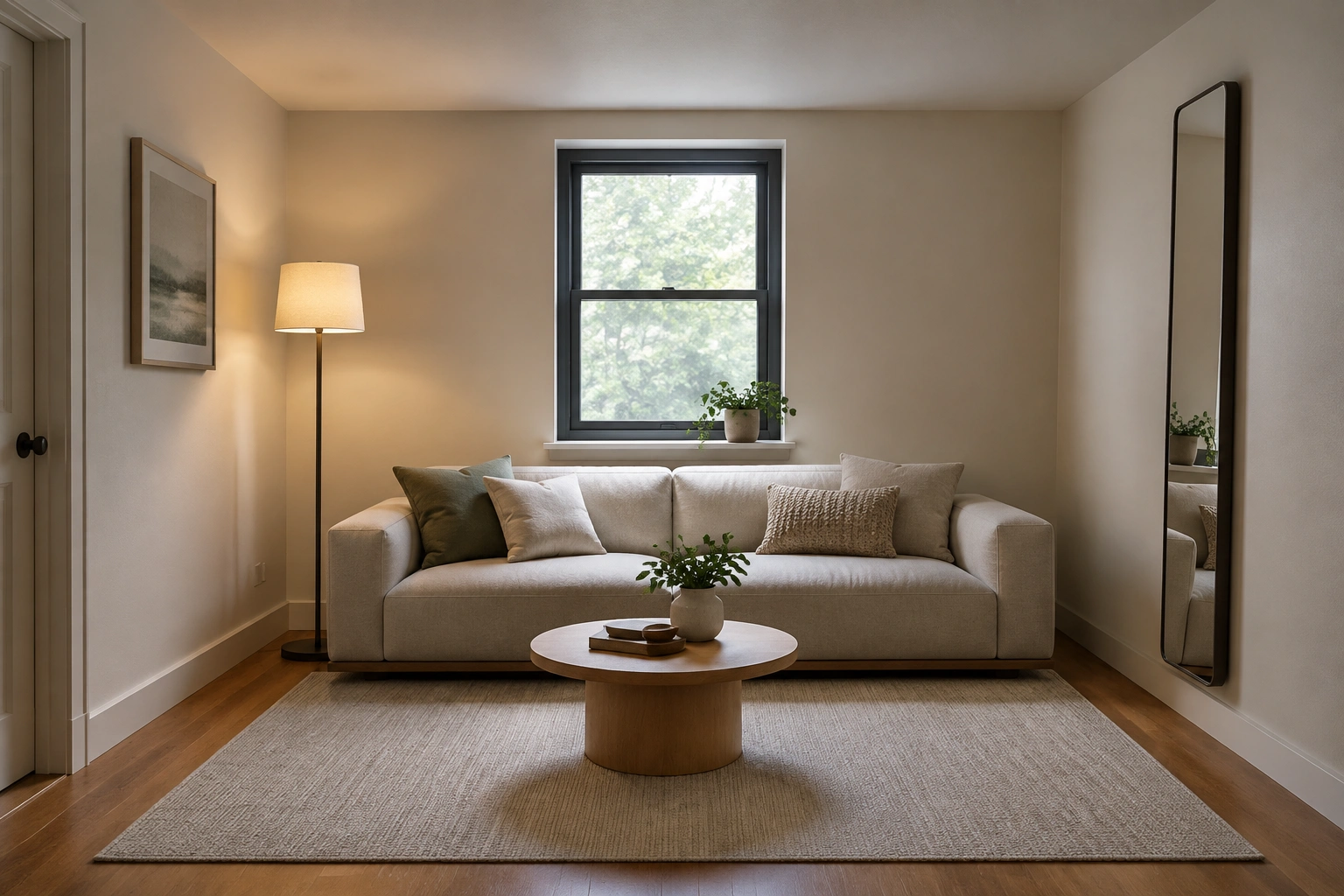
Low-profile vs. tall furniture
Low-profile furniture is usually the safer base choice. A sofa with a lower back, a streamlined coffee table, and open-legged side tables keep the room feeling lighter.
Tall furniture is not forbidden. A slim bookcase, a narrow floor lamp, or a vertical art piece can help create upward movement. The key is restraint. One or two taller accents can guide the eye up; too many can crowd the ceiling line and make the room feel compressed.
Think of it as a balance:
– Mostly low furniture for the main pieces
– A few vertical accents for height
– No oversized, blocky items that visually squat in the room
What to avoid
Avoid furniture that is both tall and visually heavy, such as oversized armoires, chunky recliners, or thick-arm sofas with very high backs. Those pieces can dominate a low room and make the ceiling feel closer than it is.
If you love a larger sofa, keep the rest of the room visually lighter so the sofa does not have to do all the heavy lifting.
Step 5: Arrange Furniture to Expose More Wall Space
The arrangement matters as much as the furniture itself. If every wall is packed, the room loses the open vertical space that helps it feel taller.
Use this simple layout strategy:
- Pull the largest pieces slightly away from the wall only if the room allows it; otherwise, keep them aligned cleanly.
- Keep the tallest pieces away from the lowest part of the ceiling if they would crowd that zone.
- Avoid blocking windows with large backs or shelves.
- Leave some wall visible above the sofa, console, or storage piece.
- Group smaller items so they feel intentional instead of scattered.
This is especially useful in very small rooms, where the temptation is to use lots of small furniture pieces. Small pieces seem flexible, but too many of them create a chopped-up look. One larger, simpler arrangement often makes the room feel calmer and taller than several tiny zones.
If you want a deeper layout system for awkward rooms, I also have a guide on how to make an awkward living room layout work without guessing.
Step 6: Upgrade Lighting Without Lowering the Ceiling Line
Lighting can either help or hurt a low-ceiling room. A fixture that hangs too low can visually cut into the room, while a flatter fixture keeps the ceiling line cleaner.
Best lighting choices for low ceilings
In most low-ceiling living rooms, the best option is:
- Flush-mount lighting — best when you need the cleanest ceiling line and the least visual drop.
- Semi-flush lighting — a good second choice if you want a little more style without sacrificing much clearance.
- Hanging fixtures — acceptable only when the ceiling height and room scale give enough clearance, and the fixture does not interrupt movement or sightlines.
If you want a decorative focal point, choose a fixture with presence rather than drop. In other words, width and shape can be more helpful than length.
Use lamps to lift the room
Floor lamps are useful because they add height without taking away headroom. A slim arc lamp or a tall, narrow lamp can support the vertical feel of the room, especially in a dark corner.
Try to avoid a cluster of short lamps and squat table lamps if the room already feels low. They can keep the visual line too close to the floor.
Brightness matters too
A dim room often feels lower because the ceiling disappears into shadow. Use layered light if you can: overhead light for general brightness, plus a floor lamp or table lamp for softer evening light. The goal is not just more light, but better distributed light.
Step 7: Add Mirrors and Reflective Surfaces Strategically
Mirrors can help a low-ceiling living room feel brighter and deeper, but placement matters more than size.
A mirror works best when it reflects something you want more of: daylight, a lamp, a pretty wall, or open space. If it reflects clutter, it doubles the problem.
Where mirrors work best
- Opposite or near a window to bounce light around
- On a wall that feels blank and heavy
- Above a low piece of furniture to add vertical lift
Tall, slim mirrors are especially useful because they echo the vertical shape you want the room to feel. A wide mirror can still help with brightness, but it may emphasize width more than height.
Use reflective surfaces sparingly. One well-placed mirror usually does more than several small shiny objects scattered around the room.
Step 8: Simplify Patterns, Rugs, and Decor
The room feels taller when the eye can move through it without interruption. That means simplifying the visual noise at floor level and eye level.
Patterns: vertical beats busy
Busy patterns can make a low room feel restless. If you want pattern, choose something that supports height rather than width. Vertical stripes, narrow repeats, or subtle texture are usually better than large horizontal motifs.
Rugs: bigger often looks calmer
A rug that is too small can chop the room into pieces. A larger rug helps furniture feel grounded as one group, which reduces the visual clutter that makes a room feel shorter. In a low-ceiling living room, continuity matters. The more the floor reads as one surface, the less distracted the eye is.
Decor: edit with intention
Keep wall decor from clustering too high or too scattered. One vertical piece of art often helps more than a row of small frames. The same goes for shelves: if they are packed with objects, they become visual weight instead of height.
A simple rule works well here: if an item does not help the room feel lighter, taller, or calmer, it probably does not need to stay.
Renter-Friendly Ways to Create Height Without Painting or Renovating
If you cannot paint or change the ceiling, focus on reversible moves.
Good renter-friendly options include:
- Tension rods or removable hardware for curtains, if the setup suits your window
- Adhesive hooks or removable curtain supports rated for the curtain weight, when the product instructions and wall surface make that safe
- Freestanding curtain solutions, such as a floor-standing curtain rod or room-divider style setup
- Tall curtain panels hung as high as your lease allows
- Plug-in floor lamps or wall sconces designed for no-hardwire use
- Large mirrors with secure anchors or leaning placement where safe
- Leaning mirrors for rooms where you cannot drill into the wall
- Slipcovered or low-profile furniture swaps
- Vertical artwork instead of wide, low gallery arrangements
These changes are especially useful in apartments where the walls are plain and the ceiling feels close. You are not trying to decorate more. You are trying to make the room read more open.
Common Mistakes That Make Low Ceilings Feel Even Lower
A few choices consistently work against you:
- Curtains hung too low: This shortens the window and the wall.
- Short curtain panels: They stop the eye too soon.
- Bulky furniture: It crowds the visible wall space.
- Oversized pendants or chandeliers: They can feel like they are hanging in the room, not from it.
- Too many small objects: They create visual noise.
- Heavy drapery in dark colors: This adds weight near the top of the room.
- Horizontal emphasis everywhere: Wide stripes, long low shelves, and low art lines can flatten the room.
If your room still feels low after making a few changes, check whether you accidentally added too much visual weight at eye level. That is often the hidden problem.
Troubleshooting: If the Room Still Feels Low or Cramped
If the room is dark
Add more reflected light before adding more decor. A mirror near a window, lighter curtains, and a brighter lamp can make a bigger difference than another pillow or picture.
If the room is narrow
Use vertical cues carefully. A tall mirror, slim lamp, and high curtain rod help. Avoid too many wide furniture pieces that make the room feel stretched sideways instead of lifted upward.
If the room is very small
Choose fewer, simpler pieces. In a tiny living room, visual clutter matters more than style quantity. One low sofa, one clean coffee table, one mirror, and one good lamp can outperform a crowded room full of “small-space” accessories.
If the windows are awkwardly placed
Let the curtains define a better shape than the window gives you. Hanging panels high and wide can make the whole wall feel more intentional, even if the actual window is low or oddly sized.
Practical Room Examples and Before-and-After Scenarios
A renter-friendly apartment living room
Before: short curtains, a dark rug, and a medium-height sofa that fills the wall.
After: off-white walls, a ceiling painted the same soft tone, floor-length curtains hung high, and a lower sofa. The room still looks small, but the ceiling no longer feels like it is pressing down.
A dim family room
Before: a hanging light fixture, a bulky sectional, and several small wall prints.
After: a flush-mount light, one large mirror opposite the window, and one tall vertical art piece. The room feels brighter and the wall line looks cleaner.
A tiny living room with awkward proportions
Before: too many small tables, short drapes, and a busy gallery wall.
After: one larger rug, streamlined seating, simple curtain panels, and fewer wall pieces. The room feels less chopped up, which makes the ceiling seem less dominant.
When to Call a Space Planner
If your room has multiple issues at once — very low ceiling, awkward windows, poor light, and an odd layout — a space planner or interior designer can help you avoid buying the wrong pieces first. That is especially useful if you are considering custom drapery, built-ins, or lighting changes that need careful placement.
For most homes, though, you can get a noticeable improvement with a few smart edits. The best strategy is usually not one dramatic fix. It is a set of small choices that all point the eye upward.
The room feels taller when the wall space stays visible, the ceiling line stays quiet, and the furniture supports the architecture instead of competing with it.
FAQ
What curtain rod height works best in a low-ceiling living room?
A good rule of thumb is to place the rod several inches above the window frame, often around 4 to 6 inches when the room allows it. If the ceiling is very low, go as high as you reasonably can without crowding trim or molding.
Should curtains touch the floor?
Yes. Floor-length panels should just skim the floor for the cleanest look in most living rooms. Avoid short curtains, which make the room feel lower.
What lighting is best for a low ceiling?
Flush-mount lighting is usually the best choice, semi-flush is the next best, and hanging fixtures work only when there is enough clearance and the fixture does not visually crowd the room.
Can renters make a low-ceiling room look taller without painting?
Yes. Use removable curtain hardware, adhesive hooks rated for the load, freestanding curtain solutions, leaning mirrors, plug-in lamps, and low-profile furniture to create height without permanent changes.
Do mirrors really help?
They can. Mirrors help most when they reflect light or open space instead of clutter. A tall, slim mirror is often a strong choice in a low-ceiling room.
What is the quickest change with the biggest impact?
High-hung floor-length curtains usually make one of the biggest visual differences, especially when paired with low furniture and a lighter wall color.