
How to Make a Small Living Room Feel Less Cramped: A Practical Room-Opening Guide

If your living room feels tight the second you walk in, the fix usually isn’t one dramatic makeover. It’s a series of small decisions that reduce visual weight, improve flow, and stop the room from fighting itself.
The fastest wins are usually these: clear out anything that blocks walking paths, choose seating that fits the room’s scale, use a larger rug to anchor the layout, and simplify the color palette so the eye doesn’t have to jump around. From there, lighting, mirrors, and smarter storage can make the room feel brighter and easier to live in.
A small living room can still feel cozy. The goal is not to make it empty. The goal is to make it breathe.
What You Need Before You Start
Before moving furniture around, gather a tape measure, painter’s tape, a notepad, and a trash bag or donation box. If you’re a renter, also keep removable options in mind: peel-and-stick hooks, freestanding shelves, and non-permanent window treatments.
Measure these things first:
- Room length and width
- Window and door placement
- Sofa or sectional dimensions
- Clearance around the main walkway
- Rug size you already own, if any
If you can, sketch the room roughly on paper. Even a simple rectangle with doors and windows marked on it helps you avoid guessing. That matters because a layout that looks fine in theory can feel cramped in real life once you need to walk around a coffee table or open a cabinet door.
Step 1: Clear the Room and Decide What Actually Belongs There
The first question to ask is not “What should I buy?” It is “What is crowding the room right now?”
Pull out anything that does not support daily life in the space. That usually includes:
- Extra side tables you never use
- Decorative stools that function as clutter magnets
- Too many throw pillows
- Oversized baskets that take up floor space without solving a real storage problem
- Random chairs that are only there “just in case”
A good rule: if an item is both visually heavy and rarely used, it is a strong candidate to leave.
This is also the moment to simplify surfaces. One large tray, one lamp, and one small stack of books usually reads cleaner than six separate objects. That lower visual noise makes the room feel less busy, even if the square footage does not change.
If you need a place to begin, clear one zone completely: the coffee table area, the corner by the window, or the wall opposite the entry. Once one section opens up, the room usually feels less boxed in right away.
Step 2: Choose a Furniture Layout That Protects Traffic Flow
A cramped room often feels worse because the path through it is interrupted. When people have to sidestep furniture, the space feels smaller than it is.
Aim to keep the main walking route obvious and direct. If your room connects to another area, leave a clear line from the doorway to the next destination. In practice, that usually means avoiding the urge to push every piece flat against the wall and call it done. Sometimes floating the sofa a few inches off the wall gives the room better balance and leaves a cleaner path.
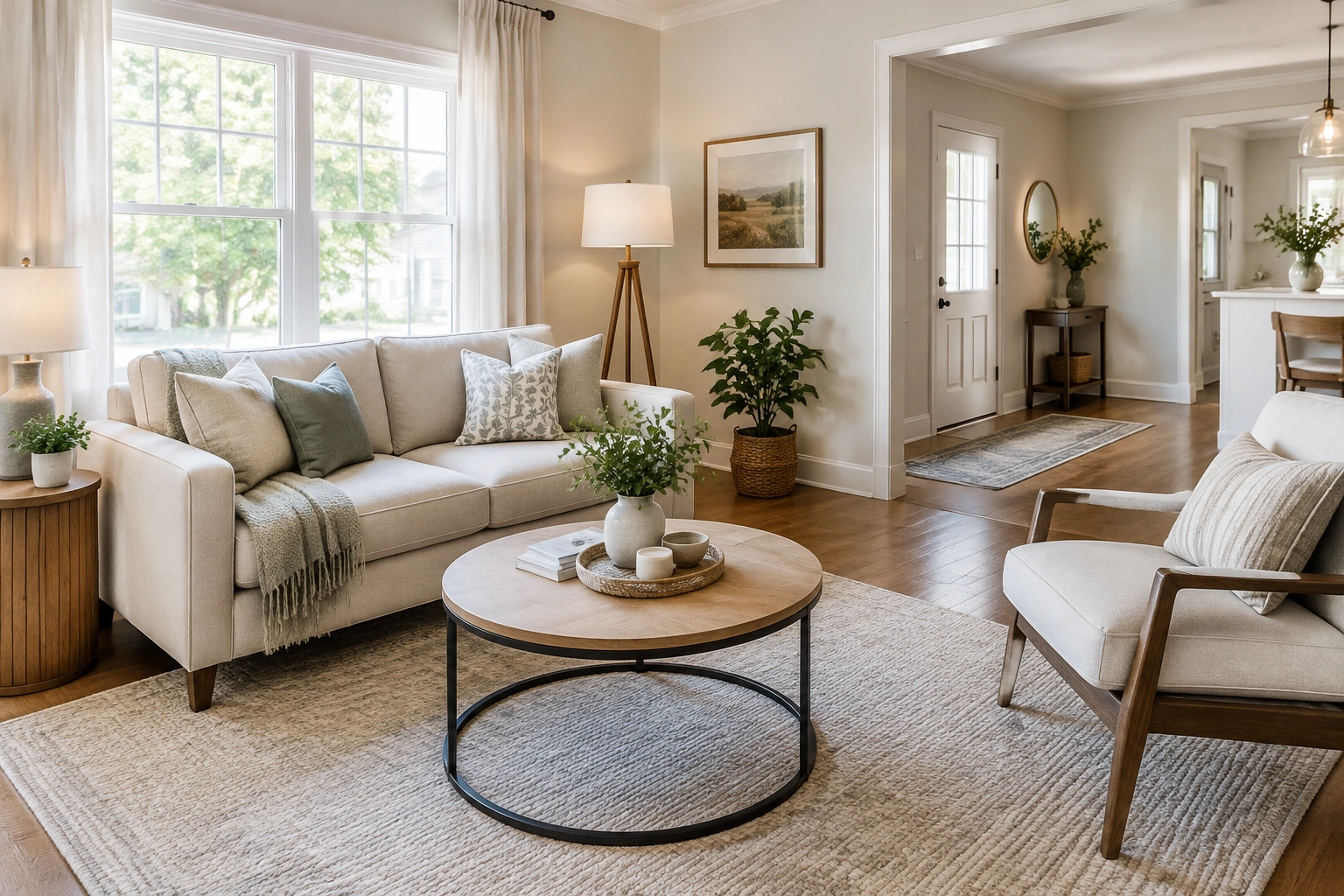
For narrow rooms, try this:
- Put the sofa on the long wall
- Keep one slim chair opposite or angled in a corner
- Use a round or oval coffee table if the room is tight
- Skip bulky end tables unless they are truly necessary
For square rooms, this often works better:
- Create a centered seating group
- Use a rug to define the conversation area
- Leave open space on at least one side for circulation
- Avoid placing every piece in the corners, which can make the center feel awkward and empty at the same time
For rooms with two doorways, a fireplace, or a TV wall, the layout needs a little more strategy. For example:
- If the fireplace is the focal point, place the main sofa facing it and keep a clear side path to the second doorway.
- If the TV wall shares space with a doorway, use a slimmer media console and angle one chair instead of blocking the opening with a bulky armchair.
- If doorways sit on opposite walls, a floating sofa with a narrow console behind it can help define the seating area without cutting off the route through the room.
If the room serves more than one purpose, zoning can help. A reading chair in one corner and the main seating area in another can make the room feel more organized, not more crowded, as long as each zone has enough breathing room. You can see a deeper breakdown of that approach in how to create zones in a small living room.
Step 3: Pick the Right-Sized Seating for the Space
Seating is usually the biggest visual decision in the room, so scale matters more than style.
Here’s a simple comparison to help you choose:
| Option | Best for | Trade-off |
|---|---|---|
| Sofa | Most everyday living rooms | Gives comfortable seating, but can dominate a very small room if it is deep or bulky |
| Loveseat | Narrow rooms or secondary seating | Saves floor space, but may not be enough if the room is your main gathering spot |
| Sectional | Families or frequent lounging | Can be efficient for seating, but the wrong size can swallow the room and block flow |
If the room is truly compact, a loveseat plus one accent chair can feel lighter than a sectional. That combo also gives you more flexibility if you rearrange later. A sectional is usually a poor choice in a very small room when it blocks a doorway, crowds the walkway, or leaves no room for a coffee table without squeezing the seating area. It makes more sense only when the footprint is large enough to handle the extra bulk.
Look for pieces with visible legs when possible. Furniture that lifts off the floor tends to feel lighter than blocky pieces that sit heavy all the way to the ground. That does not make the room bigger, but it can make it feel less visually packed.
A storage ottoman is often a smart substitute for a large coffee table if you need hidden storage or extra seating. It does double duty without asking for another piece of furniture.
Step 4: Use Light Colors and Cohesive Finishes to Reduce Visual Weight
Light colors do not have to mean all-white. In fact, an all-white room can feel stark if it has no texture. What usually works better is a soft, neutral palette with a few layered tones: warm white, beige, oatmeal, pale gray, muted taupe, or a gentle earthy color.
Neutral decor can help a small living room feel lighter and more open when it is paired with enough contrast and texture. That’s the effect you want: lighter surfaces that reflect more light without making the room feel sterile.
The key is cohesion. If the sofa is charcoal, the rug is busy, the curtains are bright white, and the pillows are five different colors, the eye keeps stopping. That visual interruption makes the room feel busier. A more unified palette lets the space read as one calm area.
If you love color, keep it in accents rather than everywhere. One patterned pillow set, one art piece, or one accent chair is usually enough to add personality without overwhelming the room.
Light vs. dark colors: which helps more?
- Light colors: better when the room is dim, narrow, or already crowded
- Dark colors: can feel rich and cozy, but they absorb more visual space and work best when balanced with plenty of light and simpler furnishings
If your room already has limited natural light, lighter upholstery and curtains usually do more for openness than dark, high-contrast finishes.
Step 5: Layer Lighting to Make the Room Feel Brighter and Deeper
One overhead light often makes a small living room feel flat. Layered lighting creates depth, which helps the room feel less boxed in.
Soft, warm overhead lighting can make a small space feel more inviting, but it works best when it is paired with other light sources. That does not mean every bulb has to be amber, but harsh cool light tends to make compact rooms feel less welcoming.
A practical lighting setup usually includes:
- One main overhead light or flush mount
- One floor lamp or table lamp near the seating area
- One additional lamp or wall-mounted light if the room still has dark corners
Here’s the simplest way to think about the three options:
- Floor lamps: best when you need light next to seating without using table space
- Table lamps: best for side tables, consoles, or surfaces that have room to spare
- Wall-mounted lighting: best when floor and table space are both limited
Pay attention to corners. A dark corner can make the whole room feel smaller than it is. Lighting that corner, even gently, can soften the edges of the room.
Step 6: Add Mirrors and Reflective Surfaces Where They Actually Help
Mirrors can help a small room feel more open, but placement matters more than size alone.
The most effective spot is usually opposite or near a window, where the mirror can bounce natural light deeper into the room. A mirror placed where it reflects clutter, a TV, or a jumble of furniture can backfire by doubling the visual noise.
Use mirrors for one of these jobs:
- Reflecting daylight
- Extending a sightline down the room
- Balancing a dark wall
- Making a narrow area feel less closed off
Reflective finishes on coffee tables, lamp bases, or frames can also help, but keep them restrained. Too many shiny surfaces can start to feel busy instead of bright.
A good test: if the mirror makes the room feel wider when you stand in the doorway, it is probably helping. If it creates glare or reflects a messy corner, move it.
Step 7: Choose Storage That Uses Vertical Space Instead of Floor Space
In a small living room, floor space is valuable. Storage that climbs upward usually works better than storage that spreads out.
Floating shelves can be useful when you want display space without a bulky bookcase. Closed storage, on the other hand, is better when the room already feels visually busy. Open shelves look lighter, but they only stay light if you are disciplined about what you place on them.
Here’s the trade-off:
- Open shelving: visually airy, good for a few books or baskets, but easy to overfill
- Closed storage: hides clutter better, usually makes the room feel calmer, but can look heavier if the unit is oversized
If your room already has a lot going on, closed storage often wins. A low cabinet or storage ottoman can hide remotes, blankets, and chargers without adding another visual layer.
For renters, a slim bookcase, wall-mounted shelf, or basket system under a console can keep the room functional without permanent changes. The goal is not more storage everywhere. It is better storage in the least noticeable places.
Step 8: Fix the Rug, Curtain, and Decor Scale Problems That Shrink a Room
A lot of small rooms feel cramped because the proportions are off.
The rug problem
A rug that is too small chops the room into pieces. A larger rug usually helps the seating area feel anchored and intentional. As a rule of thumb, choose a rug that is wide enough to sit under at least the front legs of the main seating, and ideally one that extends beyond the sofa width so the arrangement does not look like it is floating on a postage stamp. In many small living rooms, that means sizing up rather than down.
The curtain problem
Hanging curtain rods too low makes the window look shorter. Hanging them higher and wider can make the window feel more generous. Even if your windows are modest, that little visual trick helps the room feel taller and less compressed.
The decor problem
Too many tiny accessories create visual noise. A better approach is to use fewer, larger pieces where possible: one bigger artwork instead of a scattered gallery wall, one substantial vase instead of several small trinkets, one or two pillows that actually relate to the room rather than a pile of mismatched ones.
This is one of the easiest ways to make a room feel calmer without stripping out personality.
Common Mistakes That Make a Small Living Room Feel Even Smaller
These are the habits that usually cause the most trouble:
- Buying furniture before measuring
- Using a rug that is too small
- Blocking windows with tall or heavy pieces
- Filling every wall with decor
- Choosing seating that is too deep for the room
- Relying on one light source
- Keeping extra furniture “just in case”
- Mixing too many finishes, colors, and patterns at once
The biggest mistake is usually not one dramatic thing. It is the accumulation of several medium-sized things that all ask for attention.
Troubleshooting: If the Room Still Feels Cramped, What to Change Next
If you’ve already edited the room and it still feels tight, use this order of operations:
If the walkway feels blocked
Remove one piece of furniture before adding anything else. A room can often handle one less chair or table better than it can handle a tighter path.
If the room feels dark
Add a second light source before changing decor. Brightness often changes the feeling of space faster than accessories do.
If the room feels cluttered
Switch from open display to closed storage. Hidden storage usually calms the room faster than more organizing bins on view.
If the room feels awkwardly empty in the center
Use a larger rug or move the seating slightly inward. Sometimes the room feels cramped because the furniture is pushed too far apart or too close to the walls, leaving the center undefined.
If the room feels heavy
Replace one bulky piece with something slimmer or leggy. One visual “break” can make the whole room feel easier.
Practical Examples: Small Living Room Makeovers That Work
A narrow apartment living room often improves when a large sectional is replaced with a loveseat, one chair, and a round coffee table. That setup keeps the path open and avoids the hard corners that make narrow rooms feel trapped.
A small square living room can benefit from a centered rug, a compact sofa, and floating shelves instead of a bulky bookcase. That combination keeps the walls from feeling crowded and gives the room a more balanced center.
A dim living room usually feels better with a mirror near a window, lighter curtains, and two light sources instead of one. The room may not change size, but the edges feel softer and the corners less closed in.
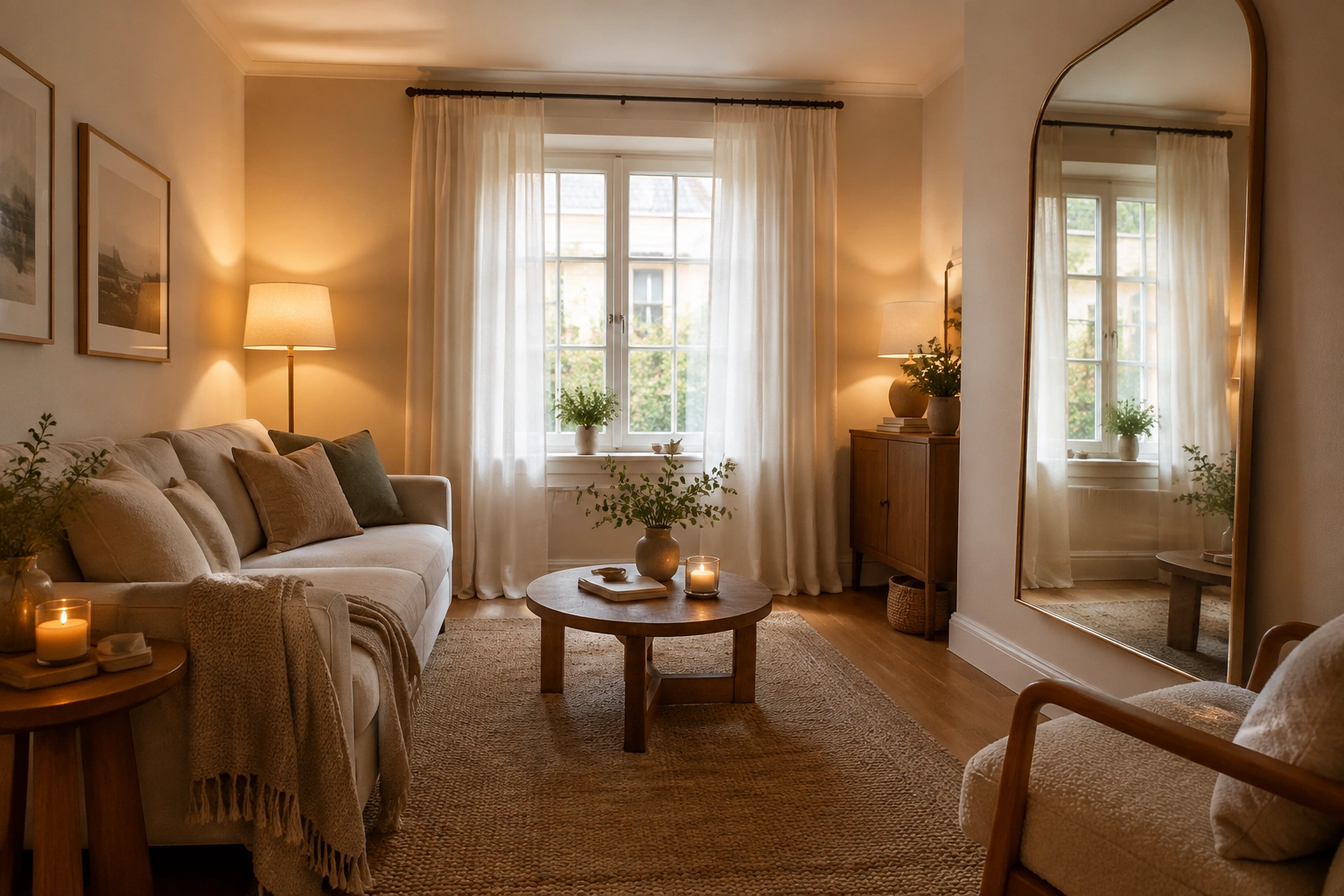
A renter-friendly room can look more open after a few simple changes: a larger rug, decluttered surfaces, a removable mirror, and a cleaner color palette. Those updates are especially useful when you cannot paint or install built-ins.
Simple Budget Plan: What to Do First If You Can Only Change a Few Things
If your budget is tight, prioritize in this order:
- Declutter and remove one unnecessary piece
- Rearrange furniture to open a clear walkway
- Add or improve one light source
- Swap to a larger or better-placed rug
- Use a mirror to reflect light
- Simplify decor and storage on surfaces
That order gives you the most visible improvement for the least money. In many rooms, the biggest shift comes from removing the wrong things rather than buying new ones.
If you do spend, spend where the room feels most constrained: seating size, lighting, or storage. Those are the pieces that affect how the room functions every day.
When to Call a Space Planner
If your living room has an unusual shape, multiple doorways, or you cannot make the seating and traffic flow work no matter how you rearrange it, a space planner can help you avoid expensive trial and error. That is especially useful if you are planning to buy a new sofa or custom-sized storage and want the layout to work the first time.
For most small living rooms, though, the answer is simpler than it seems: keep the path open, choose pieces that fit the room’s scale, and let light do more of the work.
FAQ: Small Living Room Questions Answered
What furniture layout makes a small living room feel bigger?
A layout that protects a clear walkway and uses only the seating you truly need usually feels best. In narrow rooms, a sofa on the long wall often works well. In square rooms, a centered seating group can feel more open if the rug and furniture scale are right.
Should I use a sofa, loveseat, or sectional in a small living room?
Use the piece that fits your daily life and the room’s dimensions. A loveseat is often best for very tight rooms, a sofa suits most small living rooms, and a sectional works only if it does not overwhelm circulation.
Do mirrors really help a small living room look larger?
They can help when they reflect light or extend a sightline. A mirror that bounces daylight from a window is usually more useful than one placed where it reflects clutter.
What kind of rug works best in a small living room?
A rug that is large enough to anchor the seating area usually works better than a tiny one. Small rugs can make the room feel chopped up.
How do I make a small living room feel bigger on a budget?
Declutter first, then improve the layout, lighting, and rug size before buying decor. Those changes usually give the strongest payoff without a big spend.
What decor mistakes make a small living room feel cramped?
Too many small accessories, oversized furniture, low curtain rods, dark corners, and a crowded floor plan are the biggest culprits.