
Should the Sofa Face the TV or the Window? A Practical Room Layout Guide

If you’re deciding should the sofa face the TV or the window, the short answer is this: face the TV when the room is mainly for watching, face the window when the view or daylight matters more than screen time, and choose neither when the room shape or traffic flow makes a straight-on layout awkward.
That sounds simple, but real rooms are rarely simple. A living room might have one great window, one awkward doorway, and a TV that only fits on one wall. In those cases, the best layout is usually the one that protects sightlines, reduces glare, and keeps the room easy to move through.
The goal is not to force one “correct” direction. The goal is to make the sofa support the way you actually live.
Quick Answer: Sofa Facing the TV or the Window?
Use this rule of thumb:
- Face the TV if the room is mostly for movies, shows, gaming, or daily viewing.
- Face the window if the view is the room’s strongest feature and the space is used more for relaxing or conversation.
- Face neither directly if a straight layout creates glare, blocks walkways, or makes the room feel cramped.
A sofa should usually aim toward the room’s primary focal point. That focal point might be the TV, but it could also be a fireplace, a picture window, or even a conversation zone. The best layout is the one that makes the room feel intentional instead of split into competing directions.
If the room is truly multipurpose and TV viewing and conversation matter equally, pick the feature you want to anchor the seating from the main entrance: if the TV is the more frequent use, let it lead; if the room is more about hosting, let the conversation area or window view lead.
If you want a deeper guide on the window side of the question, my practical layout guide for sofas in front of a window walks through when that setup works and when it doesn’t.
What to Check Before You Move the Sofa
Before you drag a sofa across the room, look at the room as a whole. These are the details that change the answer fast:
- Where is the strongest focal point? TV, view, fireplace, or seating conversation?
- How much glare hits the TV during the day?
- Is the window worth facing, or is it mostly just light?
- Where do people naturally walk through the room?
- Is the room narrow, square, or oddly shaped?
- Do you need the sofa to anchor a larger seating group?
A room that gets soft morning light can handle a very different layout from a room with harsh afternoon sun. A family room used for sports and streaming has different priorities than a front living room where people mostly sit and talk.
This is also where you should notice the “invisible obstacles”: radiators, floor vents, outlet locations, and doors that swing open into the seating area. Those details often matter more than the wall length.
Step 1: Choose the Room’s Primary Focal Point
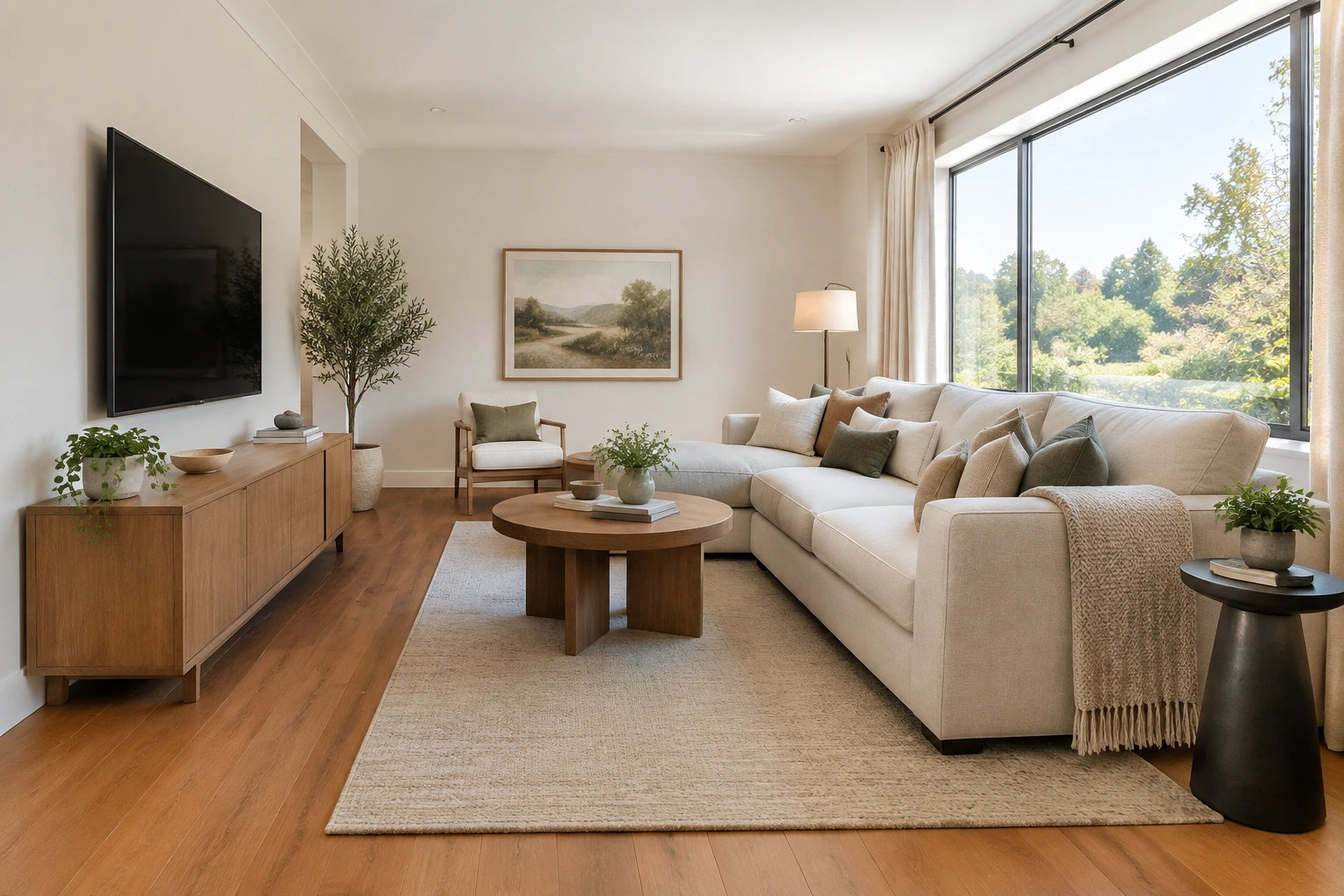
Every living room needs one clear visual leader. Without that, the furniture starts competing with itself.
In most homes, the primary focal point is one of these:
- The TV, if the room is media-centered
- The window view, if the outlook is unusually good
- The fireplace, if it dominates the room
- The conversation area, if the room is meant for gathering more than screens
A useful decision test: if you had to choose only one thing for the sofa to face, what would make the room feel most complete? That answer tells you where the sofa should point.
If the TV is the main event, center the layout around it. If the window has the best view in the room, give that view the better seat. If the room is used for conversation first, let the seating arrangement support face-to-face interaction instead of centering a screen.
Step 2: Decide Whether TV Viewing or Natural Light Matters More
This is the real trade-off.
A TV-facing layout usually gives you the cleanest viewing experience. The sofa has a direct line to the screen, and people aren’t twisting their necks to watch. That matters if the room gets heavy daily use for shows, sports, or gaming.
A window-facing layout usually gives you better daylight and a more open feeling. It can make a room feel calmer and less screen-dominated. It also works well when the window view is genuinely worth looking at.
Here’s the practical question to ask: Which one do you want to look at most when you sit down? If the answer is the TV, let that win. If the answer is the window, let the room breathe around the view.
A common compromise is to give the TV the main seating axis and let the window stay visible from the side. That keeps the room bright without turning the sofa away from the screen.
Step 3: Check Sightlines, Glare, and Screen Reflections
This step decides whether a TV-facing layout will actually work.
If the sofa faces the TV but the TV sits opposite a bright window, glare can become the dealbreaker. Reflections make the screen harder to see, especially during daytime. In practical terms, that means a layout that looks balanced on paper may feel frustrating every afternoon.
A few checks help:
- Stand where the sofa would go and look at the TV wall at different times of day.
- Notice whether sunlight lands directly on the screen.
- Check whether the TV would sit across from a window or beside it.
- Look for reflective surfaces nearby, like glass tables or glossy framed art.
For a comfortable media setup, you want a view that feels straight and easy, not one that makes you squint or keep adjusting the screen. General viewing comfort guidance also points toward reducing harsh light and awkward positioning rather than forcing a setup that feels strained.
If glare is unavoidable, that does not automatically mean the sofa must face the window instead. It may only mean the TV needs a different wall, better light control, or a slight shift away from the brightest window line.
If the TV is directly opposite a window and glare still persists after using curtains or shades, the fallback plan is to move the TV off that wall entirely if you can. Even shifting it to a nearby side wall, or turning it slightly with a swivel mount, can be more effective than trying to defeat direct sunlight head-on. If the screen must stay opposite the window, then the room usually needs a stronger combination of light control and viewing-angle adjustment; otherwise, the layout is working against itself.
Step 4: Map Traffic Flow and Clear Walkways
A sofa can face the “right” thing and still ruin the room if it blocks circulation.
Before locking in the layout, trace how people enter, cross, and leave the room. You want a path that feels natural, not one that cuts behind the sofa in a tight squeeze or sends people walking through the middle of the seating zone.
Watch for these common problems:
- A sofa placed where it blocks a doorway
- A layout that forces people to sidestep around the arm every time
- A narrow gap between sofa and wall that becomes a dead end
- A walkway that runs directly through the TV viewing area
A floating sofa can help when the room is long or when the best wall for the TV is not the wall the sofa naturally wants to sit against. It also creates a cleaner traffic lane behind the seating. For a small-room version of this problem, my small living room sofa placement guide shows how to keep movement clear without making the room feel empty.
Step 5: Choose the Best Sofa Orientation for Your Room Shape
Room shape changes the answer more than people expect.
In a small room
A straight-on layout usually works best if the TV and sofa can align without crowding the walkway. If the only window is bright and close to the TV wall, the sofa may need to face the TV and the window may need treatment.
In a narrow room
A floating sofa often works better than pushing everything to the walls. It can divide the space into zones and keep a clear path behind the seating.
In a square room
You often have more flexibility. The sofa can face the TV directly, face the window if the view is strong, or sit at a slight angle if there are two competing focal points.
In a room with off-center windows
Do not force perfect symmetry. A slightly angled sofa or a centered TV on a side wall may feel more natural than trying to line everything up with the window trim.
The best layout is the one that makes the room feel settled. If the furniture looks like it is fighting the architecture, the room will feel off even if every piece technically fits.
When the Sofa Should Face the TV
A TV-centered layout is usually the better choice when:
- The room is used mainly for watching
- The TV is on most days, not just occasionally
- The screen can be viewed straight on without neck twisting
- Window glare can be controlled
- There is a clear wall or zone for the media setup
This is the strongest option for family rooms, den-style spaces, and apartments where one living area has to do everything. If the TV is part of daily life, make the sofa comfortable for that first.
A direct sofa-to-TV relationship also helps the room feel organized. The furniture has a clear purpose, and you do not have to keep turning your body to follow the action.
When the Sofa Should Face the Window
A window-facing layout makes sense when the window is the room’s best feature and the TV is secondary.
Choose this setup when:
- The view is genuinely worth centering
- The room is used more for reading, talking, or relaxing
- TV use is occasional rather than constant
- The window brings in pleasant, not harsh, light
- Privacy is not a major issue
This arrangement can make a room feel open and calm, especially in a front living room or a space with a garden view. It works best when the window is not so bright that it washes out the screen or makes the seating area uncomfortable at certain times of day.
If you’re using this approach, think about how the TV will live in the room without taking over. A side wall or a lower-profile media setup often works better than forcing the screen to compete with the view.
Alternative Layouts: Angled or Floating Sofa Placement
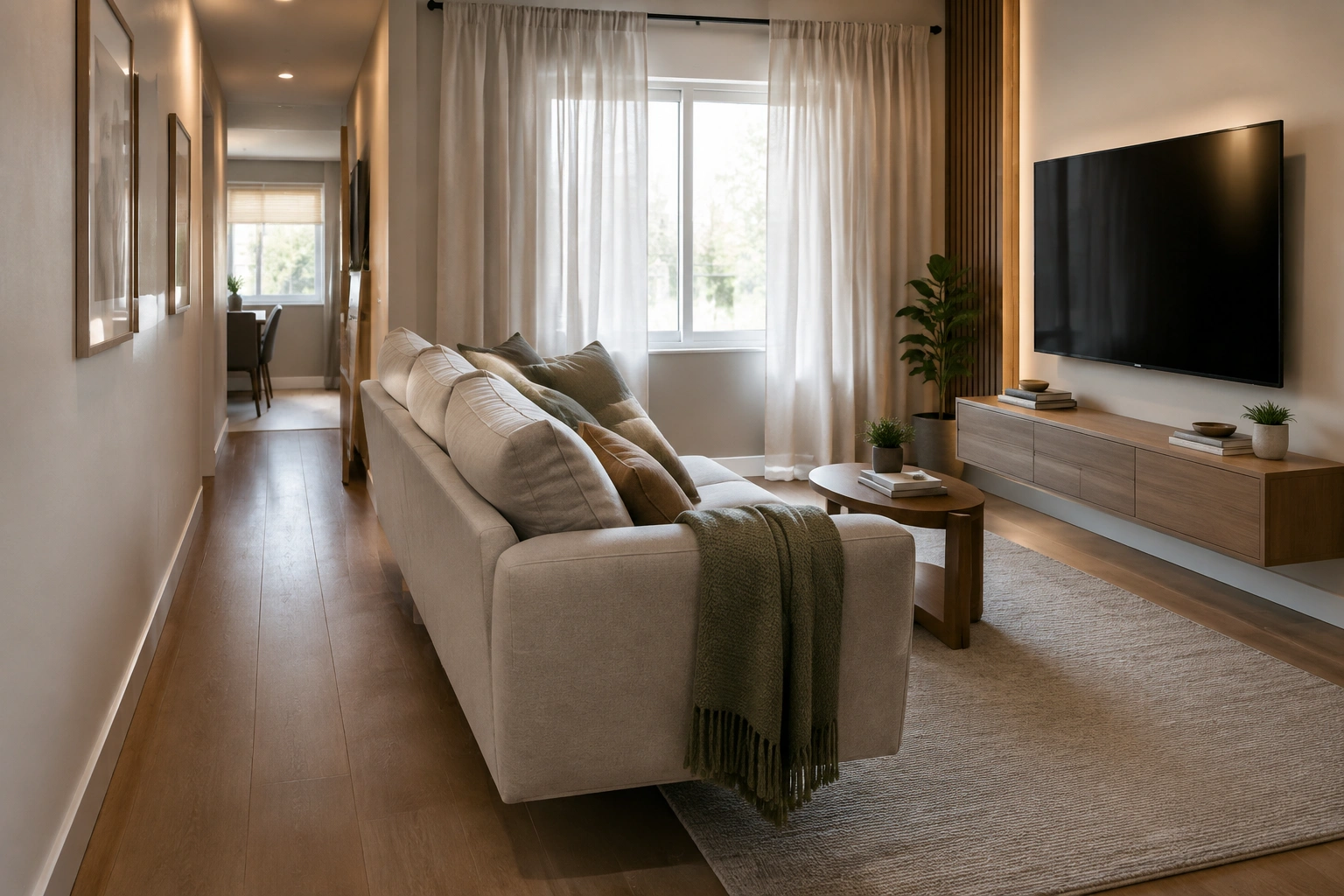
Not every room wants a straight-on answer.
Angled placement
A slight angle can soften a rigid room and improve the line of sight to both the TV and the window. It is especially useful when the TV and window are offset from each other. The trade-off is that the room may lose some symmetry.
Floating placement
Floating the sofa away from the wall can solve circulation problems and create a more balanced layout in a long room. It can also help divide a room into zones, such as a media area and a conversation area.
These options are worth considering when the room has two competing focal points and neither one should dominate completely. In those cases, a sofa does not have to “pick a side” as strongly as you might think.
How to Fix TV Glare Without Changing the Whole Layout
If the sofa already faces the TV but the window is causing reflections, try solving the light problem before you move all the furniture.
Practical fixes include:
- Curtains or shades to soften direct sun
- Blinds for more precise light control
- A slight TV repositioning away from the brightest angle
- A swivel mount if the screen needs flexibility
- A different seating angle so the sofa still faces the TV without lining up with the window glare
This is often the easiest path in real homes. You may not need a full redesign. Sometimes the room just needs better light control.
If the TV is directly opposite a window and glare still shows up after you’ve added curtains or shades, the better fix is often to move the TV to a different wall rather than keep fighting the same light path. If that is not possible, try shifting the screen off-center from the window line or using a mount that lets you angle it away from the brightest reflection. In rooms with especially stubborn glare, the layout may need to change more than the window treatment does.
If you want the sofa to stay where it is, window treatments are usually the least disruptive fix. If you want more flexibility, a screen that can turn slightly toward the seating area may help the room work at different times of day.
Practical Layout Examples
Small apartment with one window and one TV wall
- Best choice: Sofa faces the TV
- Why: In a small room, a clear viewing axis usually matters more than making the window the main feature.
- Tradeoff: You may need shades or blinds if the window throws glare across the screen.
Bright family room with a great view
- Best choice: Sofa faces the window
- Why: If the view is the standout feature, it can become the room’s anchor and make the space feel more open.
- Tradeoff: The TV will usually need to move to a side wall or secondary zone.
Narrow rectangular room
- Best choice: Floating sofa with the TV on the shorter wall
- Why: This keeps a walkway open and prevents the room from feeling like a tunnel.
- Tradeoff: The layout may feel less traditional than a sofa pushed to the wall.
Awkward room with off-center openings
- Best choice: Slightly angled sofa placement
- Why: It can balance competing doors and windows better than trying to force perfect symmetry.
- Tradeoff: The room may look less formal, but it often works better day to day.
Common Mistakes to Avoid
The most common layout mistakes are usually about forcing the room to obey the furniture instead of the other way around.
Avoid these:
- Ignoring glare and hoping you will “get used to it”
- Blocking a walkway with the sofa back
- Centering the sofa on a wall just because it looks tidy
- Making the window or TV the focal point without checking how the room is used
- Choosing symmetry when the room shape clearly wants a different solution
A room can be beautiful and still be annoying to live in. The best layout is the one that feels easy every day, not just balanced in a photo.
Troubleshooting a Layout That Feels Off
If the room feels wrong after you place the sofa, diagnose the problem instead of moving everything randomly.
- If TV viewing feels strained: the sofa may be too far off-center or angled too sharply.
- If the room feels too dark: the sofa may be blocking the best light path.
- If conversation feels awkward: the seating may all be pointing in one direction with no secondary chairs.
- If the room feels cramped: the sofa may be too close to a wall or blocking circulation.
- If the room feels unbalanced: one focal point is probably overpowering the other.
A small shift can make a big difference. Sometimes moving the sofa just enough to open a walkway or turning it a few degrees toward the main focal point is all the room needs.
Final Decision Checklist
Before you settle on the layout, ask yourself:
- Is the TV or the window the room’s true focal point?
- Will the sofa have a comfortable sightline to the main feature?
- Is glare a real issue at the times I use the room most?
- Can people move through the room without squeezing past the sofa?
- Does the layout support how the room is used most often?
- Would angled or floating placement work better than a strict face-to-face setup?
If you can answer those questions clearly, you will usually know whether the sofa should face the TV, the window, or something in between.