
What Decorating Mistakes Make a Small Living Room Look Smaller? A Practical Fix-It Guide

A small living room can feel cozy, calm, and inviting. But a few decorating choices can tip it into cramped fast. The usual culprits are not dramatic mistakes. They are scale problems, layout problems, and light problems that quietly eat up visual space.
If your room feels tighter than it should, look for these space-shrinking habits first: furniture that is too large, too many pieces, a blocked walkway, dark finishes everywhere, the wrong rug size, poor lighting, cluttered surfaces, and window treatments that steal daylight. Fixing even one or two of those can make the room feel lighter and easier to live in.
Quick Answer: The Biggest Mistakes That Make a Small Living Room Feel Smaller
Here is the short version if you want to act now:
- Oversized furniture makes the room feel crowded before you even add decor.
- Too much furniture leaves no negative space, so the room reads as packed.
- A poor layout blocks traffic flow and makes the room feel harder to move through.
- Dark or heavy colors everywhere absorb light and visually close in the space.
- A rug that is too small breaks the room into pieces instead of grounding it.
- One dim light source leaves corners shadowy and the room feels heavier.
- Too many small accessories create visual noise.
- Heavy curtains or blinds can cut off the natural light that makes a room feel open.
If you want the fastest wins, I would usually look at layout, lighting, and rug size first. Those three changes often improve the room’s feel without replacing every major piece.
Before You Start: What to Look at in Your Room
Before moving anything, take a quick inventory of the room itself. That keeps you from buying the wrong “fix.”
Check these four things:
- How much clear floor space you actually have
- Measure the main walking path from the doorway to the sofa, TV, or other main seat.
-
If you have to turn sideways or sidestep furniture, the layout is doing too much.
-
Which pieces are visually heavy
- Bulky arms, dark upholstery, skirted furniture, and solid bases all read as heavier.
-
Pieces with visible legs usually feel lighter because you can see more floor underneath.
-
Where the natural light comes from
- A room with one window needs to protect that light.
-
If the window is covered by thick drapes or a tall piece of furniture, the room can feel dim even in daylight.
-
What you can and cannot change
- Renters may need non-permanent fixes like curtains, rugs, lamps, removable wallpaper, peel-and-stick film, and furniture rearranging.
- Homeowners may have more flexibility with paint or hardwired lighting, but those changes still need to earn their place.
A useful rule: if a change does not improve scale, light, or flow, it probably will not do much for the room’s size perception.
Mistake 1: Using Furniture That Is Too Large for the Room
An oversized sofa or sectional can dominate a small living room before anything else has a chance to breathe. The problem is not just physical size. It is visual weight. A large piece can make the rest of the room feel undersized, even if the room is technically functional.
A common example: a deep sectional that fills one wall, blocks a corner, and leaves only a narrow strip for a side table or lamp. The room may still “fit” the furniture, but it will feel packed.
How to tell if a piece is too large
Ask these questions:
- Does the furniture leave a clear walkway?
- Does it crowd the doorway, window, or TV view?
- Does it force every other piece to be tiny by comparison?
- Does it sit so close to the walls that the room feels boxed in?
If you answer yes to more than one, the piece is probably too large for the space.
Better swap: apartment-size or slimmer-profile furniture
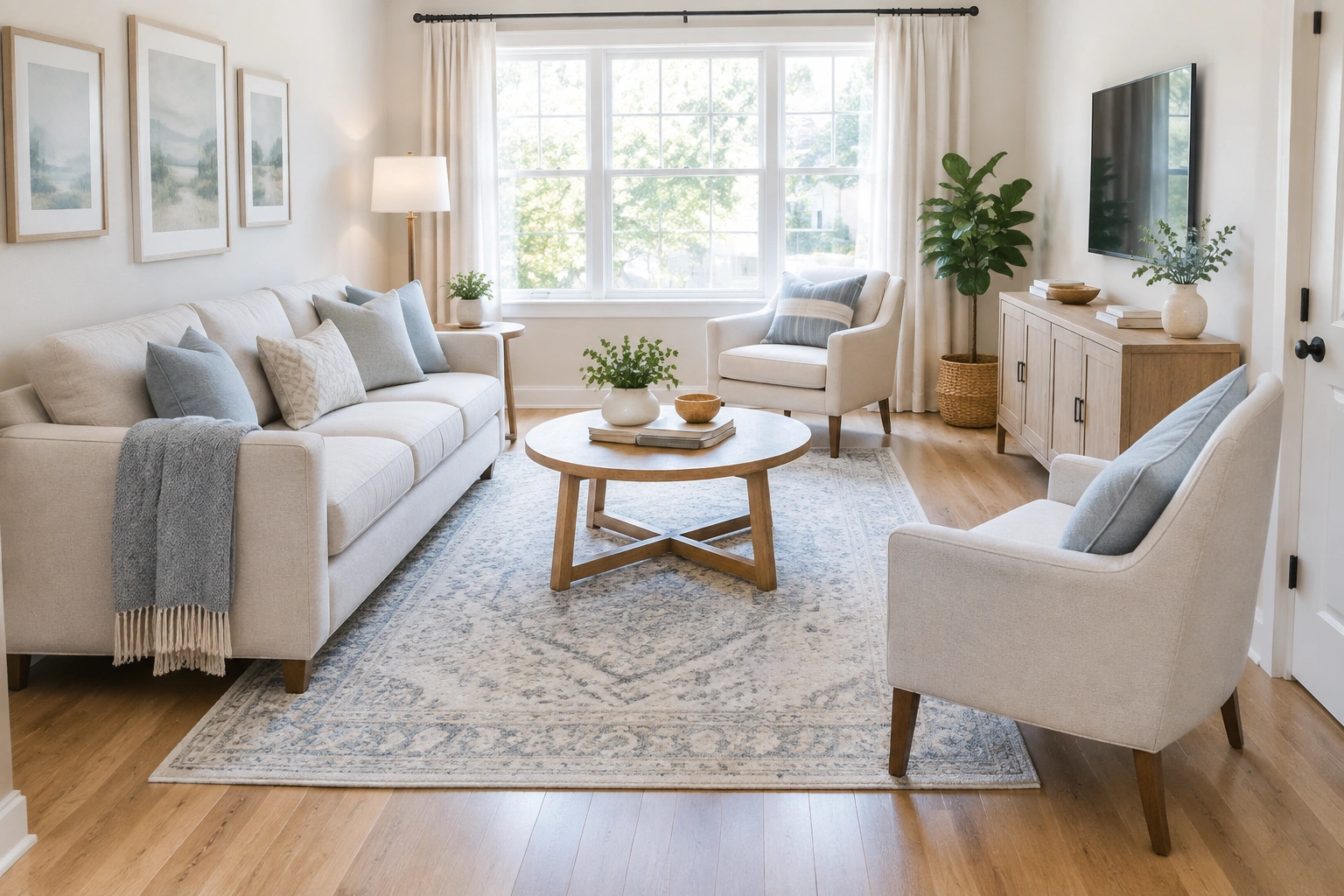
An apartment-size sofa or a smaller-profile sectional often works better than a full-size version because it keeps more visual and physical space open. A good rule of thumb is to choose the smallest sofa that still seats the people who use the room most often. In many small living rooms, that means a sofa around 72 to 84 inches wide, though the right size depends on your wall length and traffic path.
If you are deciding between sofa types, this simple benchmark helps:
– 1 sofa + 1 chair is often enough for a small living room.
– 1 sofa + 2 chairs can work if the chairs are slim and the room is not already crowded.
– A sectional is usually best only when it still leaves a clear path and does not swallow the room.
If replacing furniture is not realistic, try to reduce the visual bulk around it. A sofa with exposed legs, a lighter fabric, or a smaller coffee table can help the room feel less heavy without changing the whole setup.
Mistake 2: Filling Every Corner with Furniture or Accessories
A small living room does not need to be empty. It does need breathing room. When every corner is occupied, the eye has nowhere to rest, and the room starts to feel busier than it really is.
This is where negative space matters. Empty space is not wasted space. It helps furniture read as intentional instead of crammed in.
A simple rule of thumb for furniture count
For a small living room, start with this baseline:
– 1 main seating piece
– 1 secondary seat if needed
– 1 coffee table or ottoman
– 1–2 small support tables max
– 1–2 lighting sources
– A few decor pieces, not a collection of them
If you are adding a third chair, a second coffee table, or multiple extra stools, pause and ask whether the room truly needs them. In many small rooms, less furniture with more open floor around it works better than trying to fit in every possible piece.
What to remove first
If the room feels crowded, remove in this order:
- Extra accent chairs you rarely use
- Duplicate side tables
- Decorative baskets or stools that only add clutter
- Too many throw pillows or blankets
- Small decor items that blend together visually
A good test is to ask whether each item has a job. If it does not provide seating, storage, light, or a clear focal point, it may be taking up more visual room than it earns.
One statement piece beats many tiny pieces
A single larger art piece, one substantial lamp, or one clean tray on a coffee table usually reads calmer than a cluster of small objects. Too many small accessories can make the room feel fussy, even if each item is attractive on its own.
Mistake 3: Blocking Walkways With a Bad Layout
A small room can feel smaller simply because it is hard to move through. If the furniture creates dead ends, tight corners, or a zigzag path to the sofa, the room will feel cramped no matter how pretty it is.
One of the most common layout mistakes is pushing everything hard against the walls and assuming that creates space. Sometimes it does the opposite. It can make the room feel like furniture is floating without purpose, while the center still feels awkward.
A better layout rule
Leave a clear path where people naturally walk. That may mean floating the sofa slightly away from the wall, or angling a chair so it opens the traffic lane instead of blocking it.
If you have a TV, fireplace, or another focal point, build the layout around that anchor without forcing every piece to face it rigidly. A small living room often works best when one or two pieces are doing the heavy lifting and the rest stay simple.
For more layout help in tricky rooms, see my guides on arranging a small living room with two doors and making a small living room feel balanced.
Mistake 4: Choosing Dark or Heavy Colors Everywhere
Dark colors can be beautiful. They can also make a small room feel more enclosed if they are used on every major surface. Deep paint, dark upholstery, heavy wood tones, and dark textiles all absorb light and create visual weight.
That does not mean you must avoid dark colors completely. It means you should use them with intention.
Light versus dark in a small room
- Light colors usually reflect more light and feel airier.
- Dark colors can add depth and coziness, but too much can make the room feel closed in.
A practical small-room palette often looks like this:
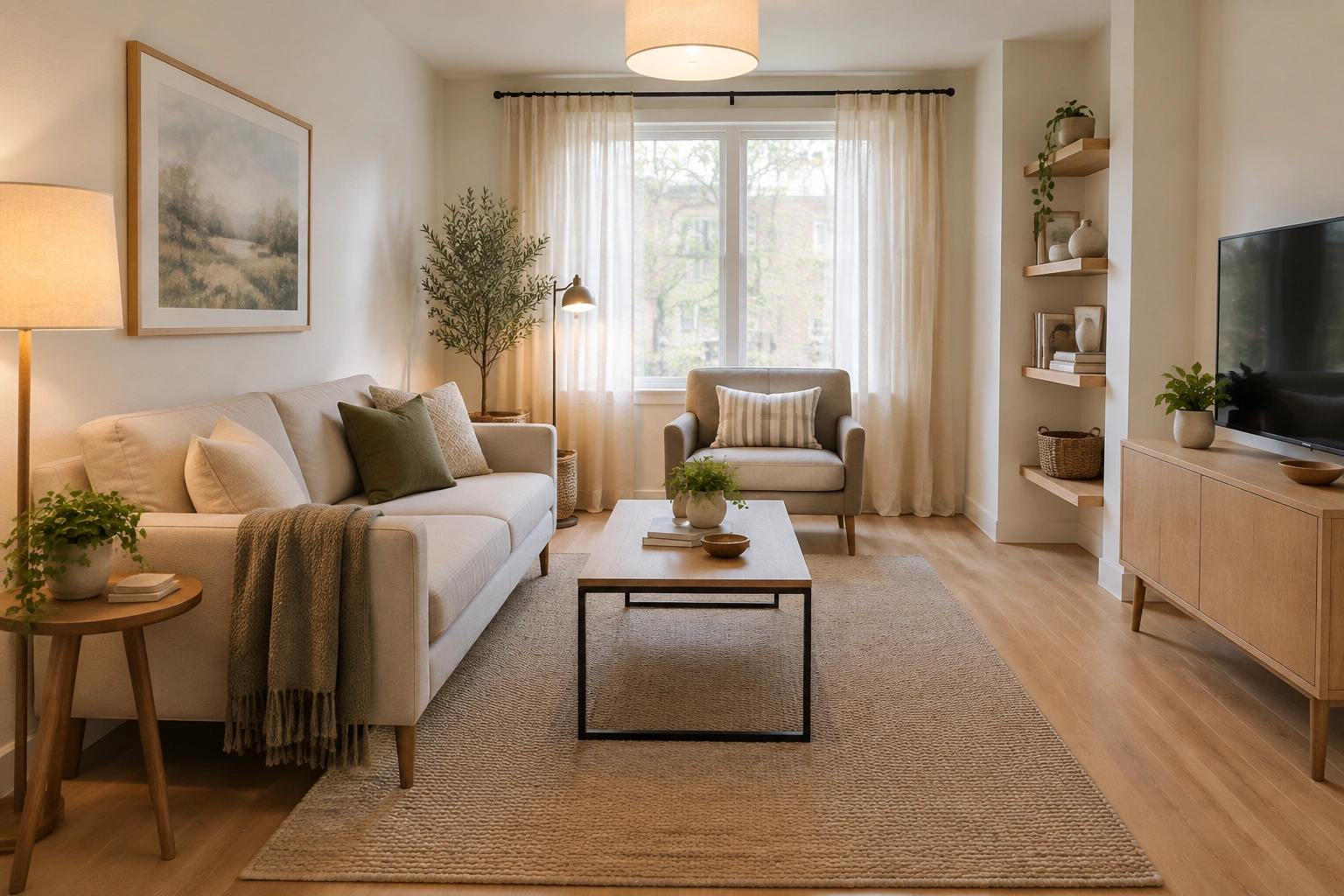
– warm white or soft cream on the walls
– light oak or natural wood accents
– a beige, oatmeal, or pale gray sofa
– one deeper accent color in a pillow, throw, chair, or art print
If your room already lacks natural light, a dark wall color plus dark curtains plus a dark sofa can make the whole space feel cave-like. Dark colors work best when they are balanced by light surfaces, visible legs, and plenty of daylight. If you love darker tones, keep them in smaller doses: a pillow, a throw, a chair, or a single accent wall rather than the entire room.
Finish matters too
Not all light colors feel the same. A matte finish can feel softer, while a subtle sheen can bounce more light. On the other hand, too much shine can feel busy. The goal is not glare. It is brightness with calm.
Mistake 5: Using the Wrong Rug Size or Placement
A rug can make a small living room feel grounded and complete. The wrong rug can do the opposite. When the rug is too small, it can make the furniture look disconnected, like each piece is floating in its own zone.
A simple rug sizing rule of thumb
A practical rule is to choose a rug that is large enough for at least the front legs of the main seating pieces to sit on it. In many small living rooms, that means:
– 5×8 works only in very compact rooms or under a smaller seating group
– 6×9 is often a safer choice for a small living room
– 8×10 can still work if the room is small but open enough to handle it
If the rug only sits under the coffee table, it is usually too small. If the rug is so large that it crowds the walls or doors, it is too big. The sweet spot is a rug that helps the seating area feel like one connected zone.
What usually goes wrong
A tiny rug placed only under the coffee table often chops up the room. Instead of anchoring the seating area, it creates a little island in the middle of a larger space.
Better rug logic
Choose a rug that helps the main seating pieces feel related to one another. In many small living rooms, that means the front legs of the sofa and chairs sit on the rug, or the rug extends enough to visually connect the group.
A larger rug usually makes the room feel more deliberate, but there is a trade-off: it costs more and may be harder to fit around doors or awkward corners. A too-small rug is usually the more damaging mistake, though, because it makes the room feel fragmented.
If you are unsure, err on the side of slightly larger rather than obviously smaller.
Mistake 6: Relying on One Dim Light Source
A single overhead light can flatten a room and leave corners in shadow. Shadows make a small room feel heavier because the eye reads darkness as closed-in space.
This is where layered lighting helps. You do not need a fancy plan. You need more than one source of light at different heights.
A simple lighting mix that works
- Overhead light for general brightness
- Table lamp or floor lamp for warmth and depth
- Optional accent light to brighten a dark corner or highlight art
A floor lamp near a chair, for example, can make the room feel more finished while also reducing the “one bright spot, many dark corners” problem. If you are a renter, this is one of the easiest ways to improve the room without changing anything permanent.
A general design principle also helps here: hang window treatments high enough to make the window feel taller, but do not block the daylight you are trying to keep.
Mistake 7: Styling Walls, Shelves, and Surfaces Too Heavily
A small room can handle decor. It cannot always handle clutter disguised as decor.
Too many framed pieces, crowded shelves, and busy mantel displays create visual noise. The room starts to feel like it has too many competing stories. That makes the space seem smaller because the eye never settles.
Cleaner styling choices
Try these edits:
- Replace a cluster of tiny frames with one larger piece
- Leave some shelf space open instead of filling every inch
- Keep the coffee table to one tray, one stack of books, and one object
- Use fewer but better-shaped accessories
Wall art do-and-don’ts for small rooms
Do:
– Hang one larger piece above the sofa instead of several tiny ones
– Keep art centered over the furniture below it
– Leave enough wall space around the piece so it can breathe
Don’t:
– Hang art too low, where it crowds the sofa or console
– Use a loose cluster of very small frames that looks scattered
– Fill the wall above the sofa with too many pieces, which can make the seating area feel compressed
As a simple benchmark, art above a sofa usually looks better when it is roughly two-thirds the width of the sofa or when a single piece is large enough to read clearly from across the room.
Shelf styling do-and-don’ts
Do:
– Mix a few heights and shapes
– Leave some open space between objects
– Repeat one or two materials for consistency
Don’t:
– Pack every shelf from edge to edge
– Line up only tiny objects, which can look busy and underwhelming at the same time
– Use so many books and knickknacks that the shelf becomes the focal point of the room
Mantel decor do-and-don’ts
Do:
– Keep the mantel simple with one focal piece and a few supporting items
– Use asymmetry if it feels lighter
– Leave some empty space so the fireplace still stands out
Don’t:
– Create a crowded row of small frames, candles, and objects
– Stack decor in front of the fireplace opening or crowd the edge of the mantel
– Treat the mantel like a shelf that needs to be filled completely
A good shelf display usually has a mix of heights and some empty space between items. If every shelf is packed edge to edge, the whole wall can feel busy even when the objects are attractive.
Open legs help here too
Furniture with open space underneath can make the room feel lighter, especially when the walls already have enough visual activity. A solid, bulky media unit plus crowded shelves can make the whole room feel top-heavy.
Mistake 8: Using Heavy Window Treatments That Block Light
Windows are valuable in a small living room because they bring in the light that makes the space feel open. Heavy drapes, dark panels, or blinds that stay closed most of the time can reduce that effect.
This is one of the easiest mistakes to overlook because the room may still look “finished.” But if the window covering blocks daylight, the room often feels smaller than it needs to.
Better window treatment choices
Look for coverings that let in light when privacy allows:
- Lighter curtain panels
- Sheer layers
- Roman shades that can be raised during the day
- Curtain rods mounted high enough to keep the window looking tall
Rental-friendly alternatives
If you cannot paint or make permanent changes, you still have options:
- For color: use a colorful rug, pillows, throws, art, or a slipcovered chair instead of wall paint
- For light: add a floor lamp, table lamp, or plug-in wall sconce instead of rewiring
- For windows: try lightweight curtains, tension rods, or removable film for privacy instead of heavy blinds or permanent treatments
If you are renting, even swapping a heavy panel for a lighter one can make a noticeable difference. The trade-off is privacy versus openness, so think through how you use the room at different times of day.
Practical Fixes That Make the Biggest Difference Without Replacing Everything
If you want the highest impact for the least effort, I would prioritize changes in this order:
- Clear the walkway
-
Move anything that interrupts the natural path through the room.
-
Simplify the seating
-
Keep only the pieces the room truly needs.
-
Upgrade the rug
-
A better-sized rug can help the whole room feel connected.
-
Add one more light source
-
A floor lamp or table lamp can soften shadows fast.
-
Reduce visual clutter
-
Edit shelves, mantels, and tabletops.
-
Let more daylight in
-
Swap heavy window coverings for lighter ones if you can.
-
Adjust the furniture profile
- When possible, trade one bulky piece for something with legs or a slimmer silhouette.
These are not glamorous fixes, but they are the ones that usually change the room’s feel the most.
Numbered Step-by-Step: How to Make a Small Living Room Look Bigger
1. Clear the room enough to see it honestly
Remove obvious extras first. You need to see the floor and the walls before you can judge scale.
2. Measure the furniture that matters most
Check the sofa, coffee table, rug, and any large storage piece. If one item overwhelms the room, that is your first candidate for change.
3. Map the traffic path
Walk through the room the way a person actually would. If the route feels awkward, rearrange before buying anything.
4. Choose the biggest visual problem
Usually it is one of three things: oversized furniture, poor lighting, or a too-small rug. Fix the worst offender first.
5. Lighten the room in layers
Add or improve lighting before you add decor. Brightness often makes the room feel larger faster than styling does.
6. Edit decor down to a few intentional pieces
Keep what supports the room’s shape and function. Remove the rest.
7. Reassess before spending more
After the first round of changes, live with the room for a day or two. Sometimes the room only needs one more adjustment, not a full overhaul.
Common Mistakes to Avoid While You Are Fixing the Room
A few overcorrections can backfire:
- Adding too many small pieces because the room still feels unfinished
- Buying a rug that is still too small and hoping it will “work”
- Pushing furniture too tightly against the walls without improving the path through the room
- Mixing too many finishes so the room feels visually busy again
- Replacing one bulky piece with several smaller pieces that create more clutter
The goal is not to fill the room better. It is to make the room feel more open, easier to read, and less visually crowded.
Troubleshooting: What to Fix If the Room Still Feels Cramped
If the room still feels small after your first round of changes, use this symptom-based check:
-
It feels hard to walk through
The layout is still the problem. Rework traffic flow before anything else. -
It feels dim or cave-like
Add a second light source or lighten the window treatment. -
It feels busy even when it is tidy
You likely still have too many small decor items or too many competing colors. -
It feels heavy at eye level
Look at wall art, shelves, and curtain placement. -
It feels chopped up
The rug may be too small, or the furniture may be spaced too far apart.
Sometimes the room does not need more decoration. It needs less interruption.
Practical Examples: Small Living Room Before-and-After Scenarios
Scenario 1: The oversized sectional problem
A renter has a sectional that nearly touches the doorway and leaves no room for a side table. The fix is not necessarily replacing everything. First, remove one extra chair, pull the sectional back if possible, and use a lighter rug and a floor lamp to reduce the visual bulk. If the sectional still overwhelms the room, that is when a smaller sofa becomes worth considering.
Scenario 2: The dark-and-dim room
A homeowner has dark curtains, a dark accent wall, and a heavy TV unit. The room feels closed in even during the day. Swapping to lighter curtains, adding a floor lamp, and reducing the amount of dark decor on the opposite wall can make the room feel less boxed in without repainting immediately.
Scenario 3: The cluttered but functional room
A small living room has enough seating, but every surface is filled with small decor. The room is tidy, yet it feels busy. The fix is to remove several small objects, keep one large art piece, and simplify the coffee table styling. The room does not become empty. It just becomes easier to read.
Scenario 4: The rental-friendly refresh
A renter cannot paint or install anything permanent. They use a larger rug, lighter curtains, one extra lamp, and a slimmer coffee table with legs. Those changes do not alter the square footage, but they do make the room feel more open and intentional.
FAQ
What size sofa works best in a small living room?
A smaller-profile sofa or apartment-size sofa usually works best. In many small rooms, a sofa around 72 to 84 inches wide is a practical starting point, but the best size depends on your wall length, walkway, and whether you need additional seating.
How much furniture is too much for a small living room?
A simple rule of thumb is to start with one main seating piece, one secondary seat if needed, one coffee table or ottoman, and one or two support tables at most. If the room starts feeling crowded or the traffic path narrows, you probably have too much furniture.
What rug size should I choose for a small living room?
Choose the largest rug that still fits the room comfortably. In many small living rooms, a 6×9 rug is a safer choice than a tiny 5×8, and the front legs of the main seating pieces should usually sit on the rug.
Are dark colors always bad in a small living room?
No. Dark colors can work if they are balanced with lighter surfaces, good lighting, and visible floor space. They tend to be a problem when they are used on every major surface in a room that already lacks natural light.
What are the best renter-friendly fixes for a small living room?
Use removable or non-permanent changes: lighter curtains, peel-and-stick window film, floor lamps, rugs, slipcovers, pillows, and art. These can improve color, light, and softness without requiring paint or permanent installation.
When to Call a Space Planner
If you have tried the layout, lighting, rug, and furniture edits and the room still feels awkward, a space planner or interior designer can help you solve a more specific problem: unusual door placement, a tricky fireplace, an off-center window, or a room that has to serve too many functions at once. That kind of help is especially useful when you are deciding whether to keep a large piece or replace it.
The goal is not perfection. It is a room that feels easy to live in. In a small living room, that usually comes from fewer visual obstacles, better light, and furniture that respects the size of the space.