
Do Large Rugs Make Small Rooms Look Bigger? A Practical Guide for Small Spaces

Yes — a large rug can make a small room look bigger, but only when it is the right size, placed well, and visually calm enough to unify the space.
That last part matters. In a compact room, the goal is not simply to cover more floor. The goal is to create one clear seating or sleeping zone so the room feels intentional instead of chopped into little pieces. A rug that is too small can leave the layout feeling busier. A rug that is too large, too dark, or too patterned can also overwhelm the space, depending on the room’s lighting, furniture scale, and shape.
If you want the short version, here’s the rule I use most often: choose the largest rug your layout can comfortably handle, while still leaving a visible border of floor around the edges and keeping walkways open.
Why Rug Size Changes How Big a Room Feels
A rug affects perception because it changes how your eye reads the floor.
When a room has several small visual “islands” — a tiny rug here, bare floor there, chair legs floating over nothing — the space feels broken up. Your eye keeps stopping and restarting. In a small room, that fragmentation can make the room feel even tighter.
A larger rug helps create a more continuous visual field. It gives the furniture one shared base, which can make the room feel calmer and more cohesive. That doesn’t physically add square footage, of course, but it can make the floor feel less chopped up and the layout easier to read.
There are three design ideas at work:
- Negative space: A visible border of floor around the rug keeps the room from feeling sealed off.
- Furniture anchoring: When the rug connects the main pieces, the layout feels deliberate.
- Scale and proportion: A rug that matches the size of the furniture reads as part of the room, not as a decorative afterthought.
That’s why a rug that is too small is often the wrong move in a small room. It may seem like it preserves more floor, but visually it can create more clutter.
What to Measure Before Choosing a Rug
Before you shop, measure the room and the furniture footprint, not just the empty floor.
You only need a few tools:
- Tape measure
- Painter’s tape
- A simple sketch of the room
- Sofa, bed, or table dimensions
- Door swing and walkway clearance
Start by measuring the room’s usable width and length, then measure the furniture group you want the rug to support. After that, check the border you can leave between the rug and the walls, and make sure traffic paths still stay open. In a small room, that order matters because the walkway often limits the rug size before the furniture does.
Then map the area you actually want the rug to define. In a living room, that might be the seating zone. In a bedroom, it may be the bed and the space where your feet land. In a dining room, it’s the table plus the pulled-out chairs.
Painter’s tape is especially useful. Tape the rug dimensions on the floor so you can see how much border remains and whether the layout still breathes. This is the fastest way to avoid buying a rug that looks good on paper but feels awkward in the room.
If you already know the room is tight, measure the walkways first. A rug should support circulation, not fight it.
How to Choose the Right Rug Size for a Small Room
The best rug size is usually the largest one that still respects the room’s edges and traffic flow.
Here’s the decision framework I use:
Choose a larger rug when:
- The rug can connect the main furniture pieces
- There is still visible floor around the perimeter
- Doors can open freely
- Walkways remain clear
- The room has enough width that the rug won’t press into every edge
Choose a smaller rug when:
- A larger rug would block a door swing
- The room is so narrow that the rug would touch too many walls
- The rug would force furniture into awkward positions
- You need more visible floor to keep the room from feeling heavy
A helpful visual target is to leave a border of floor around the rug rather than letting it run wall-to-wall. That border acts like breathing room. If the rug fills every inch, the room can start to feel boxed in.
Common small-room sizing examples
These are general starting points, not rules. The best choice still depends on furniture scale, lighting, and room shape.
- Small living room:
- A 5×8 rug can work under a compact seating group or in a tighter apartment layout.
- An 8×10 is often better if you want the sofa and at least the front legs of chairs to sit on the rug.
-
A 9×12 can work in a small room only if the room is unusually open or the furniture is scaled up; otherwise it may crowd the perimeter.
-
Small bedroom:
- A 5×8 often works for a full bed or for placing the rug across the lower half of the room.
- An 8×10 is a good option when you want more rug visible around a queen bed.
-
A 9×12 is usually only appropriate if the bedroom is closer to medium-small than truly compact.
-
Small dining area:
- A 5×8 may fit a small table, but only if chairs still stay on the rug when pulled out.
- An 8×10 is often a safer choice for a four-seat table.
- A larger size may be needed if the chairs are wide or the table seats more people.
A simple rule: if the rug leaves only a thin rim of exposed floor and makes the room feel tight at the edges, size down. If the rug looks disconnected from the furniture, size up.
Step-by-Step: Place a Rug So the Room Feels More Spacious
1. Define the main zone first
Decide what the rug is supposed to hold together. In a living room, that’s usually the sofa and chairs. In a bedroom, it’s the bed. In a dining area, it’s the table and chairs.
2. Measure the wall-to-rug border and traffic paths
Before you tape anything out, measure how much floor you want to show around the rug and check the main walking routes. Make sure the rug will leave space at the walls and not interfere with door swings, closets, or hallways.
3. Tape out the rug size on the floor
Use painter’s tape to mark the rug dimensions after you’ve checked the border and traffic paths. This makes it easy to compare sizes side by side and see whether the layout still feels open.
4. Center the rug on the furniture group, not the room
A rug that is centered on the furniture usually looks better than one centered only on the room’s architecture. The furniture is what the eye reads as the main shape.
5. Keep the front legs on the rug in tighter rooms
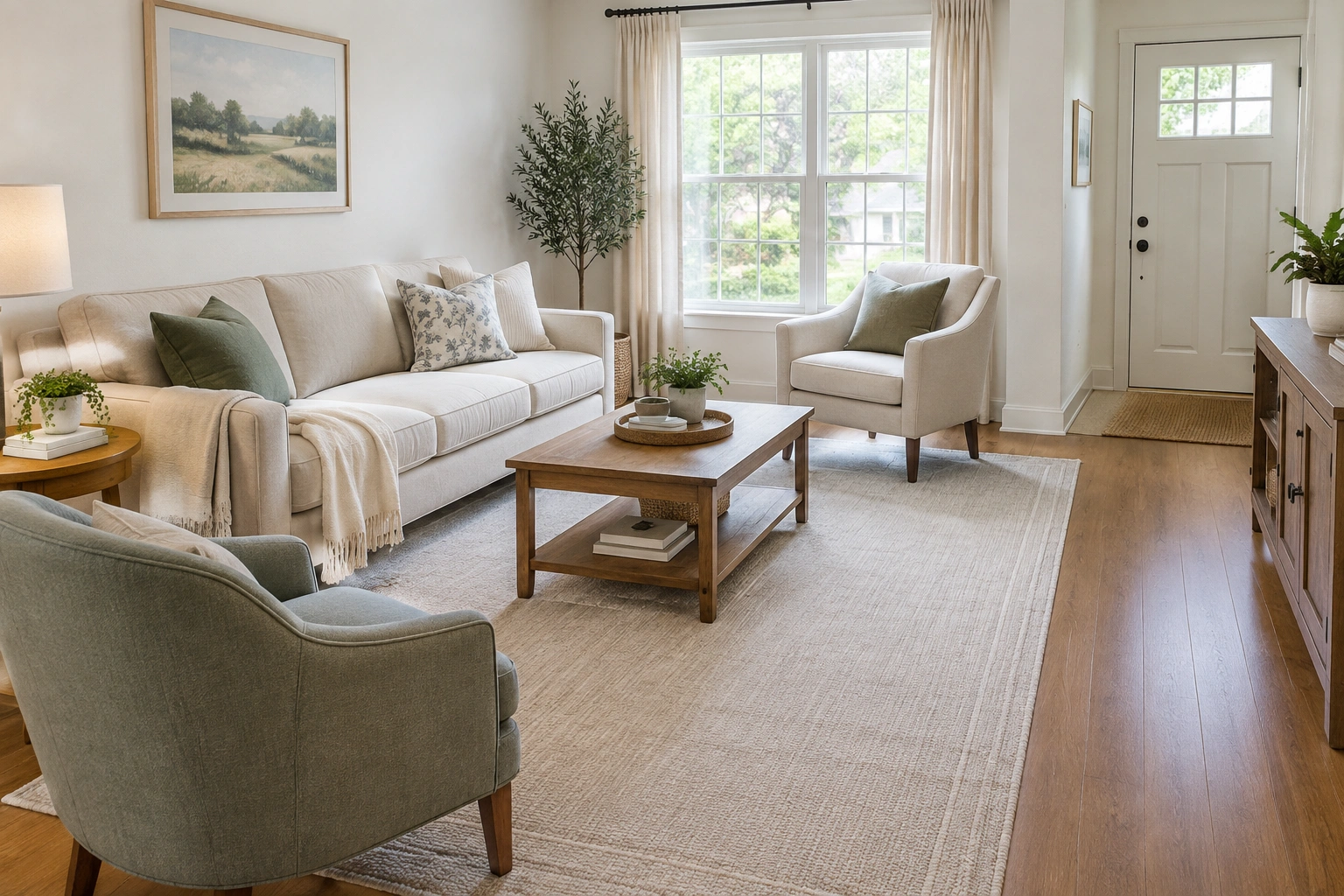
If the room is compact, placing just the front legs of the sofa and chairs on the rug can be enough to connect the seating area without crowding the floor. This works well when a full furniture-on-rug setup would use too much visible floor or block circulation.
6. Use all-furniture-on-rug placement when the room can handle it
If the room is slightly larger or the furniture cluster is more open, putting all the main pieces on the rug creates a stronger sense of unity. It usually makes the layout feel more polished and calm.
7. Check the edges
Look for awkward slivers of exposed floor between the rug and the walls or between the rug and nearby furniture. Odd little strips can make the room feel poorly planned. If the rug is creating those fragments, test a different size.
8. Walk the path
Stand up and move through the room. If the rug interrupts the natural route to a doorway, closet, or hallway, it is too large or placed too close to the traffic lane.
Best Rug Color, Pattern, and Texture Choices for Small Rooms
Size does a lot of the work, but color and pattern can either support the effect or undo it.
Light rug vs. dark rug
Light-colored rugs often help a room feel more open because they reflect more light and keep the floor plane visually softer. That is especially useful in small rooms with limited daylight or in layouts where the rug needs to blend quietly with the furniture.
Dark rugs can work, too, but they tend to ground the room more strongly. In a bright room with enough natural light, a dark rug can feel cozy and intentional. In a dim room, though, a dark rug may make the floor feel heavier.
Solid rug vs. patterned rug
A solid rug or a very low-contrast pattern usually feels calmer in a small room. It lets the eye move across the floor without stopping.
A bold, high-contrast pattern can still work in a small room when the rest of the space is fairly simple — for example, if the walls are light, the furniture is streamlined, and there are not many competing prints. In that case, the rug can become the main visual feature instead of adding to the clutter.
Texture matters too
Subtle texture is often better than loud pattern. A rug with gentle weave variation adds interest without making the floor feel busy. That’s a useful middle ground if you want warmth and dimension without extra visual clutter.
Here’s the trade-off in plain terms:
- Light + simple: brightest, most open look
- Dark + simple: grounded, cozy, can still work in a bright room
- Light + patterned: airy but more active
- Dark + patterned: strongest visual weight, easiest to overwhelm a small room
Which Rug Shape Works Best in a Small Room?
Most small rooms work best with a rectangular rug because it matches the shape of sofas, beds, and dining tables more naturally.
Rectangular rugs
Best when you want:
– Easy alignment with furniture
– Clean walkways
– A layout that feels orderly and predictable
Rectangles usually help a room look longer or more structured, especially when the furniture already has straight lines.
Round rugs
Best when you want:
– A softer look
– Relief from boxy furniture
– A small nook or corner to feel less rigid
A round rug can be a smart choice in a tiny reading area, a breakfast corner, or a room with a lot of straight edges that feels visually stiff. But in a standard living room, round rugs can be trickier to anchor because they don’t connect rectangular furniture as efficiently.
If your room is already narrow, a round rug may leave too much unused floor around the furniture. That can be charming in the right setup, but it is not always the most space-expanding choice.
Room-Specific Examples
Small living room
In a compact living room, a rug that reaches under the front legs of the sofa and chairs often makes the seating area feel connected without swallowing the floor.
If the rug is too small, the coffee table and seating can look like they’re floating separately. That disconnect can make the room feel busier. A larger rug usually helps the layout feel more settled.
If you’re also working on furniture placement, this pairs well with how to make a small living room feel balanced and how to create zones in a small living room.
Small bedroom
In a bedroom, a larger rug can make the room feel calmer by extending beyond the sides and foot of the bed. That creates a more continuous visual field and gives your feet a soft landing.
If the room is very tight, you may not need a rug that runs under every piece of furniture. What matters most is that the rug feels intentionally related to the bed, not like a small mat stranded in the middle of the room.
Small dining area
For a dining area, the rug should be large enough that chairs still sit on it when pulled out. If chairs catch on the edge every time someone sits down, the rug is too small for the job.
This is one place where going bigger usually helps both the look and the function. A rug that is too tight under a dining table can make the whole nook feel cramped.
Common Mistakes That Make a Small Room Feel Smaller
The most common mistake is choosing a rug that is too small.
A rug that is undersized in a small room can make the layout feel more fragmented, especially when it sits far away from the furniture it is supposed to support. Other mistakes to avoid:
- Leaving too much bare floor around a tiny rug
- Using a busy, high-contrast pattern in an already active room
- Blocking door clearance or traffic flow
- Placing the rug so it looks detached from the furniture
- Choosing a dark rug in a room that already lacks light
- Letting the rug create awkward uncovered patches instead of one clear zone
If the room feels cramped after the rug is in place, the issue is usually not the rug itself. It’s the relationship between rug size, furniture placement, and visual weight.
Troubleshooting: When a Large Rug Still Feels Too Heavy
If you went bigger and the room still feels crowded, look at the following culprits.
The rug is too dark
A large dark rug can feel like a visual block in a small room. If the room lacks natural light, try a lighter tone or a lower-contrast pattern.
The rug is too busy
A large patterned rug can make the floor feel active instead of calm. If the room already has patterned pillows, curtains, or wall art, simplify the rug.
The rug is crowding the perimeter
If the rug touches too many walls or nearly fills the room, it may be too large for the space. Even a well-chosen rug needs some visible floor around it.
The furniture layout is fighting the rug
Sometimes the rug is fine, but the furniture is placed too far apart or too close to the walls. In that case, the room may need a better seating cluster rather than a different rug.
The room has too many competing focal points
A large rug works best when it creates calm beneath the room. If the room also has oversized art, heavy drapery, and several bold decor pieces, the rug may not get the chance to do its job.
When that happens, simplify one layer at a time. Often the fastest fix is not replacing the rug — it’s reducing the visual noise around it.
A Simple Rule of Thumb to Remember
If you want a small room to feel bigger, choose the largest rug that still leaves breathing room around the edges and supports the furniture layout.
That usually means:
– enough rug to connect the main pieces
– enough floor visible to keep the room from feeling boxed in
– enough simplicity in color and pattern to let the room settle visually
A rug can absolutely help a small room feel larger. The trick is making it look intentional, not oversized for the sake of size.
FAQ
Do large rugs really make small rooms look bigger?
They can. A well-sized large rug creates a more continuous visual field and reduces the chopped-up look that small rugs often cause.
Should furniture legs go on the rug?
Usually yes, at least the front legs in tighter rooms. That helps anchor the furniture and makes the layout feel more connected.
Is a light rug better than a dark rug in a small room?
Often, yes. Light rugs tend to reflect more light and feel more open, especially in rooms that are already dim.

Can a rug be too large for a small room?
Absolutely. If it crowds the edges, blocks traffic, or makes the room feel heavy, it is too large for that layout.
What shape is best for a small room?
Rectangular rugs usually work best because they align easily with most furniture. Round rugs can work in nooks or softer layouts, but they are less universal.
How much floor should show around the rug?
Enough to create a visible border. If the rug nearly touches every wall, it can start to feel cramped rather than spacious.
Should I choose a solid or patterned rug?
If your room already has a lot going on, a solid or low-contrast rug is usually the safer choice. Busy patterns can make a small room feel more crowded, though a higher-contrast pattern can still work when the room is otherwise simple and bright.
When should I call a space planner?
If the room has multiple entry points, awkward angles, or you cannot get the rug and furniture to work together without blocking circulation, a space planner can help you solve the layout faster than trial and error.