
How to Make a Narrow Living Room Look Wider: 10 Practical Design Moves That Work

A narrow living room can feel cramped fast, but you usually do not need a renovation to improve it. The biggest wins come from how you place furniture, choose scale, and control what the eye notices first. If you want the room to feel wider, think in terms of visual width, not just square footage.

The quickest changes are usually the same few moves: open the center path, use fewer but better-sized pieces, choose a rug that fits the seating area, hang curtains high and wide, and keep the room bright with layered lighting. Add one mirror where it reflects light, not clutter. Those changes can make the room feel calmer and less hallway-like.
Here’s the basic rule I use when styling small spaces: if a piece blocks movement, chops the room into too many parts, or creates visual bulk, it is working against you.
What You Need Before You Start
Before moving anything, gather a measuring tape, painter’s tape, and a notebook or phone for sketching the room. If you are shopping, measure the sofa, rug, and any chair or table you already own. For a narrow room, dimensions matter more than style labels.
Helpful items to have on hand:
- Measuring tape
- Painter’s tape for marking furniture footprints
- A rug size guide or your current rug measurements
- Curtains or drapery panels that can reach the floor
- A lamp or two if the room feels dim
- A mirror, if you have a wall that can reflect light
- A few storage baskets or bins for quick decluttering
If you are a renter, focus on non-permanent changes first: furniture placement, textiles, lamps, and mirrors. If you own the home, you can also consider paint and window treatments, but layout still does most of the heavy lifting.
1. Measure the Room and Find the Narrowest Points
Measure the full length and width of the room, then mark doors, windows, radiators, vents, and any awkward bump-outs. The narrowest point matters because that is usually where traffic gets squeezed and where the room starts to feel tight.
I like to sketch the room and draw the walking path first. If people need to cut around a coffee table, squeeze between chair arms, or step sideways to reach a seat, the layout is probably too tight.
Look for these pressure points:
- The spot where the room feels most pinched
- The main path from entry to seating
- Any furniture that interrupts the line of sight
- The window wall, which often becomes the visual anchor
If the room is long and narrow, the goal is not to fill every inch. It is to make the room read as one open zone instead of a corridor with furniture.
2. Choose a Furniture Layout That Opens the Center
In a narrow living room, the center of the room is often the most valuable space. If every piece hugs the walls, the room can start to feel like a tunnel. A better plan is to define a seating zone and leave a clean route around it.
This is where layout matters more than decoration. Apartment Therapy has a helpful example of pulling some zones into the center of a long, narrow room instead of pushing everything to the wall; that variation keeps the eye moving and makes the space feel more like a room than a hallway. Apartment Therapy’s long narrow living room ideas
A practical layout rule:
- Put the largest piece first, usually the sofa
- Keep a clear walkway through or around the room
- Let chairs and tables support the sofa instead of competing with it
- Avoid creating two separate furniture islands unless the room is long enough to handle them
Here are a few concrete layout examples for very narrow rooms:
- Sofa parallel to the long wall: This often works best in the tightest rooms. Keep the sofa against one long wall, place a narrow coffee table in front of it, and leave the opposite side open as the main walkway. If you have a TV, put it on the short wall at the end of the room so it does not crowd the walkway.
- Sofa perpendicular to the long wall: This can work when the room is long enough to support a more defined seating zone. Place the sofa across the room to create a boundary, then keep a clear path behind or beside it. A TV usually works best on the short wall opposite the sofa, as long as the distance still feels comfortable.
- Floating sofa in a long narrow room: Pull the sofa slightly off the wall and use a slim console behind it if you need storage or a place for lamps. This can help the room feel more intentional, but only if the walkway still stays clear.
- TV without narrowing the room: Mount the TV on the short wall whenever possible, or place it on a low, slim media console. Avoid putting a bulky TV cabinet along the long wall if it blocks circulation or makes the room feel more like a corridor.
If your room is only slightly narrow, a centered seating arrangement can work well. If it is very tight, a slim wall-side arrangement may be better, as long as the middle of the room does not become blocked by oversized furniture.
3. Decide Whether to Float Furniture or Keep It on the Walls
This choice depends on whether you need visual breathing room or physical floor space. Floating furniture means pulling at least one major piece, usually the sofa, slightly away from the wall. Wall-hugging means pushing furniture tight to the perimeter.
Floating furniture works best when:
- The room is long and needs a stronger seating zone
- You want to create a more intentional conversation area
- There is enough room to keep a clear path behind or beside the sofa
Wall placement works best when:
- The room is very tight and every inch matters
- The sofa is already small and the walkway is narrow
- Floating the sofa would make the circulation path awkward
Here is the trade-off: floating furniture can make a room feel more designed and less like a corridor, but it can also take away usable floor space if the room is truly tiny. Wall placement saves inches, but too much wall-hugging can make the room feel stretched out and flat.
If you do float the sofa, even a small gap can help. A narrow console behind it can add function without making the room feel heavier.
4. Use the Right-Size Sofa, Chairs, and Coffee Table
Scale is one of the biggest reasons narrow rooms feel cramped. A sofa with deep cushions, thick arms, and a heavy frame can overpower the space even if it technically fits. The same is true of oversized accent chairs and chunky coffee tables.
Look for pieces that feel visually lighter:
- Sofas with slimmer arms
- Raised legs that let you see more floor
- Chairs with open sides or a smaller footprint
- Coffee tables with a lighter profile rather than a solid block
A few proportion guidelines can help:
– In many narrow rooms, a slimmer-arm sofa reads lighter than one with wide, padded arms.
– A narrower coffee table or oval table often works better than a deep, bulky one.
– Try to leave roughly 24 to 30 inches of walkway clearance where people need to pass, if the room allows it.
That does not mean the room should look sparse. It means the furniture should leave some visual air around it. In a narrow room, seeing more floor usually helps the room feel wider.
A sectional can work if it fits the room without blocking circulation, but separate sofa-and-chair seating often gives more flexibility. If a sectional dominates the room or forces the walkway into an awkward shape, it is probably the wrong fit. A sofa with one or two smaller chairs is often easier to balance in a narrow layout.
5. Pick an Area Rug That Makes the Seating Zone Feel Broader
A small rug can make a narrow room feel chopped up. A larger rug often does a better job of anchoring the seating area and creating one clear zone. The point is not to cover every inch of floor; it is to make the furniture look intentionally grouped.
A good rug choice usually does three things:
– Extends beyond the front legs of the sofa and chairs
– Fits the seating group as one unit
– Leaves enough floor visible around the edges so the room still breathes
If the rug is too small, each piece of furniture feels like it is floating separately. That can make the room seem narrower because the eye keeps stopping and starting. A larger rug creates one broad visual shape, which helps the room feel more unified.
For a narrow room, I usually prefer a rug that is wider than people expect, as long as it still leaves a border of floor around the perimeter. That border matters; it keeps the room from feeling swallowed.
6. Choose Colors and Wall Treatments That Visually Expand the Space
Light, neutral colors tend to reflect more light and soften hard boundaries, which is useful in a narrow room. Dark colors can be beautiful, but they usually absorb more light and may make walls feel closer together unless the room has strong lighting and enough contrast to balance them.
If you are choosing between light and dark paint, ask this:
– Does the room already get generous natural light?
– Do I want the walls to recede or feel dramatic?
– Will the furniture and decor stay light enough to balance the wall color?
If the answer leans toward “small” or “dim,” a lighter palette is the safer choice.
Some designers also recommend carrying paint to the ceiling or color-drenching the woodwork to reduce visual breaks in the room. Homes & Gardens notes both of those approaches as ways to help a narrow room look wider. Designer tricks for making a narrow room look wider
That said, these techniques work best when the room needs softness and continuity. If you love contrast, you can still use it in smaller doses through pillows, art, or a single accent chair rather than on every surface. A darker wall can still work in a narrow room if the space has good daylight, layered lighting, and enough lighter furniture or trim to keep the room from feeling closed in.
7. Hang Curtains to Make Windows and Walls Feel Wider
Curtains can change the proportions of the room faster than people expect. Full-length panels create a cleaner vertical line than short curtains, and mounting them higher than the window frame can make the window feel taller. Some designers also place the curtain rod wider than the window so the glass area looks broader when the panels are open.
That visual lift matters because narrow rooms often feel compressed from top to bottom as well as side to side. When the eye travels upward, the room feels less boxed in. JJones Design Co. points out that designers often focus on height in compact rooms and recommends mounting drapery higher than the window frame to create that effect. How to make a small room look bigger without knocking down walls
A few practical curtain rules:
– Let the panels touch or skim the floor
– Hang them high if the ceiling height allows it
– Extend the rod wider than the window when possible
– Choose fabric that drapes cleanly rather than bunching heavily
Short curtains tend to cut the wall visually and make the room feel lower, which usually makes a narrow space feel even tighter.
8. Add Mirrors and Reflective Surfaces Strategically
A mirror can help a narrow room feel brighter and more open, but placement matters. The best mirror is the one that reflects something worth seeing: daylight, a window, a lamp, or an open part of the room.
Good mirror placements include:
– Opposite a window to bounce light
– On a wall that feels dark or closed in
– Near a lamp to spread brightness farther into the room
Avoid placing a mirror where it reflects clutter, a TV screen, or a crowded furniture cluster. That just doubles the visual noise.
If you want a less obvious reflective effect, try glass or light-toned surfaces on a coffee table, side table, or cabinet. Use this carefully. Too many shiny surfaces can make the room feel busy instead of open.
9. Layer Lighting to Reduce the Cramped Feeling
One overhead light is rarely enough in a narrow living room. When light pools in one spot and leaves the corners dim, the room feels smaller and more tunnel-like. Layered lighting helps spread brightness more evenly.
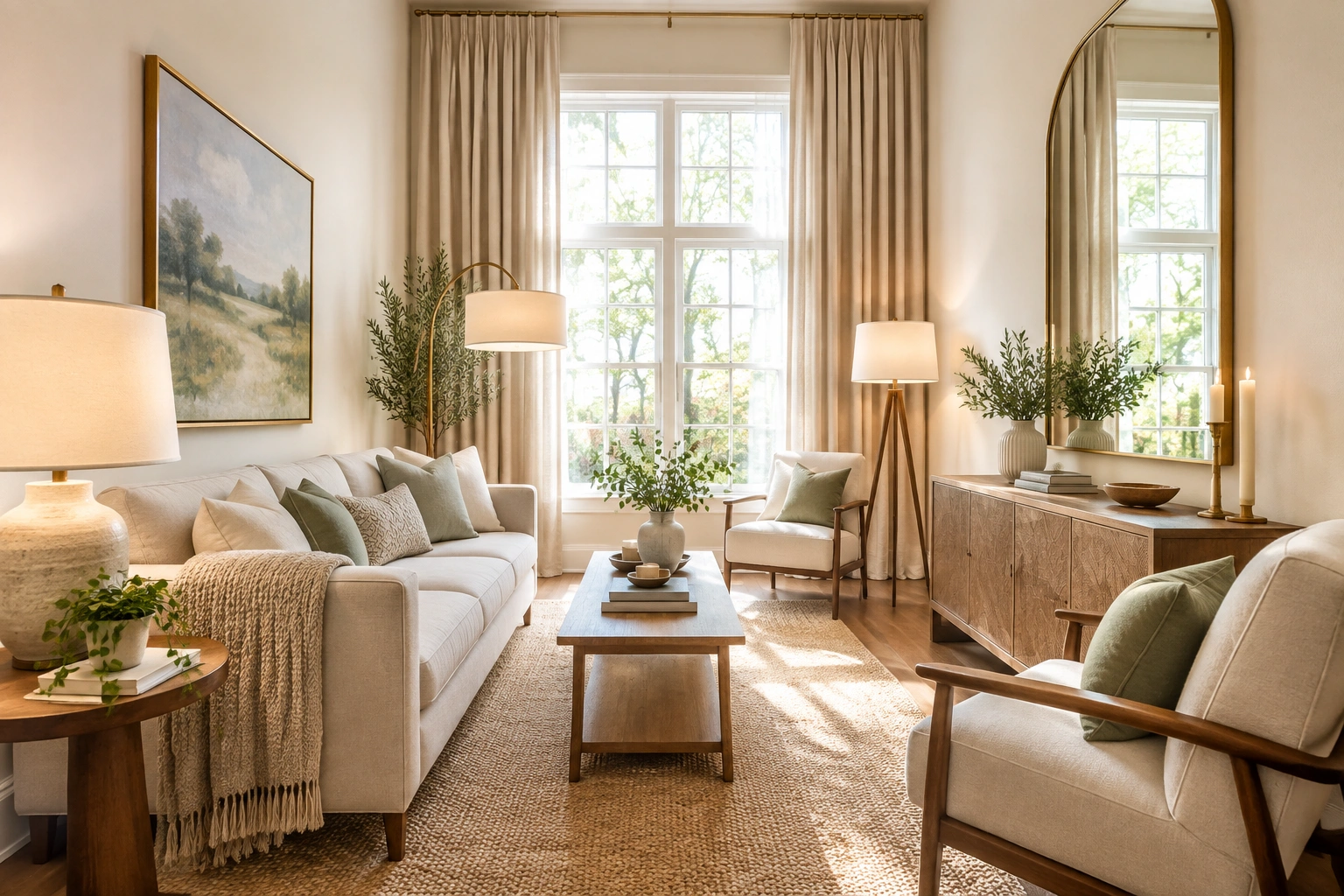
Use three types if you can:
– Ambient lighting for overall brightness
– Task lighting for reading or work
– Accent lighting to lift dark corners or highlight art
A floor lamp at one end of the room and a table lamp on the other can do more for perceived width than a brighter bulb in one central fixture. The goal is even light, not harsh light.
If your room has a dark end, brighten that end first. The eye reads darkness as depth, so a dim back corner can make the whole room feel longer and narrower than it really is.
10. Edit Decor and Keep Negative Space
This is the part many people skip. Narrow rooms do not usually need more stuff; they need better spacing. Negative space gives the eye room to rest, and that rest makes the room feel broader.
Try this edit:
– Remove one or two small decorative items from every surface
– Replace several tiny accents with one larger piece
– Keep tabletops mostly clear
– Leave some wall space open instead of filling every inch
Many small objects can make a room feel chopped up. A few larger, calmer pieces usually look more intentional and less crowded. If you love display styling, group items into fewer clusters rather than scattering them everywhere.
For more help balancing scale in tight rooms, I also recommend reading my guide on how to make a small living room feel balanced and this breakdown of how to make an awkward living room layout work.
Quick Comparison Table: What Usually Helps Most
| Choice | Better for width? | Best use | Main trade-off |
|---|---|---|---|
| Floating furniture | Often yes | Long rooms that need a defined seating zone | Uses more floor space |
| Pushing furniture to walls | Sometimes | Very tight rooms | Can feel like a hallway |
| Large rug | Usually yes | Unifying the seating area | Must fit the room well |
| Small rug | Usually no | Very small accent zones | Can chop up the room |
| Sectional | Sometimes | Rooms that need maximum seating | Can dominate narrow spaces |
| Sofa + chairs | Often yes | Flexible narrow layouts | May seat fewer people |
| Light colors | Usually yes | Dim or compressed rooms | Can show wear more easily |
| Dark colors | Sometimes | Rooms with strong light and contrast | Can feel heavier |
| Full-length curtains | Usually yes | Rooms that need more height | Less practical near tight furniture |
| Short curtains | Rarely | Few situations | Visually shortens the wall |
Common Mistakes That Make a Narrow Living Room Feel Smaller
A few habits make narrow rooms feel tighter almost immediately:
- Using a sofa that is too deep or too bulky
- Buying a rug that is too small for the seating area
- Hanging short curtains that stop above the floor
- Blocking the main walkway with a coffee table or chair
- Filling the room with many small decor items
- Using dark, heavy finishes everywhere
- Adding too many separate furniture pieces that break up the room
- Lighting only one part of the space and leaving the rest dim
If the room feels off, check the floor plan first. Most narrow-room problems are layout problems before they are decorating problems.
Troubleshooting: What to Change If the Room Still Feels Tight
If the room still feels cramped after your first pass, use this decision guide.
If the sofa is too large
Replace it with a slimmer profile or move to a sofa-and-chair arrangement. A large sofa can be the main reason the room feels pinched, even if everything else is right.
If the walkway is blocked
Pull the coffee table in closer, remove one chair, or shift the seating zone so the walking path is obvious. A clear path usually improves the room faster than any decor change.
If the room feels dark at one end
Add a lamp, lighten the window treatment, or place a mirror where it can bounce brightness farther into the room.
If the room feels chopped up
Reduce the number of furniture pieces and accessories. One larger rug and fewer, better-sized items often make the room feel more continuous.
If the room feels long but not wide
Use side-to-side visual lines: a wider rug, a horizontal art arrangement, or a sofa that sits in a way that visually stretches across the room.
Budget-Friendly and Renter-Safe Fixes
You can make a real difference without painting or buying all new furniture. The most effective renter-safe changes are usually the simplest.
Try these first:
– Rearrange the furniture to open the center
– Swap a small rug for a larger one
– Move lamps to the darker end of the room
– Hang curtains higher with removable hardware if allowed
– Use a mirror to reflect light
– Remove one bulky chair or side table
– Replace cluttered decor with fewer, larger pieces
If you are on a budget, spend first on the items that affect scale: rug, curtains, and lighting. Those three usually change the room’s proportions more than decorative accessories do.
Practical Layout Examples That Work in Narrow Living Rooms
Example 1: Very narrow apartment living room
Use a slim sofa against one long wall, one chair angled across from it, and a rectangular coffee table with enough clearance to walk through. Keep the rug large enough to unify the seating, and use floor-length curtains to soften the window wall.
Example 2: Long room with a hallway feel
Float the sofa slightly away from the wall and place a narrow console behind it. Add two chairs or a small reading nook in the middle section so the room feels like a destination, not a pass-through.
Example 3: Narrow room with too much furniture
Remove one accent chair, choose a lighter coffee table, and simplify the decor. Then add a mirror opposite a window and a lamp in the darkest corner. The room often feels wider once the visual clutter is gone.
Example 4: Narrow room with a sectional
Keep the sectional only if it leaves a clear walkway and does not crowd the window or entry. If it dominates the room, swap to a sofa-and-chairs layout for better flow.
When to Call a Space Planner
If your narrow living room has multiple doors, built-ins, sloped ceilings, or a layout that keeps defeating every arrangement you try, a space planner can help you avoid expensive mistakes. That is especially useful when you are about to buy new furniture and need to know what will actually fit.
For most rooms, though, you can get surprisingly far with a tape measure, a better layout, and a few visual fixes.
Final Takeaway
If you are asking how do you make a narrow living room look wider, the answer is usually better flow, smarter scale, and fewer visual interruptions. Open the center, choose furniture that fits the room instead of crowding it, use a rug that unifies the seating area, and let light travel farther with curtains, mirrors, and layered lighting. Those changes do not just make the room look wider — they make it feel easier to live in.