
Should a Small Living Room Have a Focal Point? A Practical Layout Guide

A small living room does not have to have a focal point in the dramatic, magazine-cover sense. But it usually does need one clear visual anchor so the room feels settled instead of scattered.
That anchor might be a fireplace, a TV, a window, a piece of art, or even a simple rug-and-lamp grouping. The point is not to “decorate more.” The point is to give the eye a place to land so the room reads as intentional.
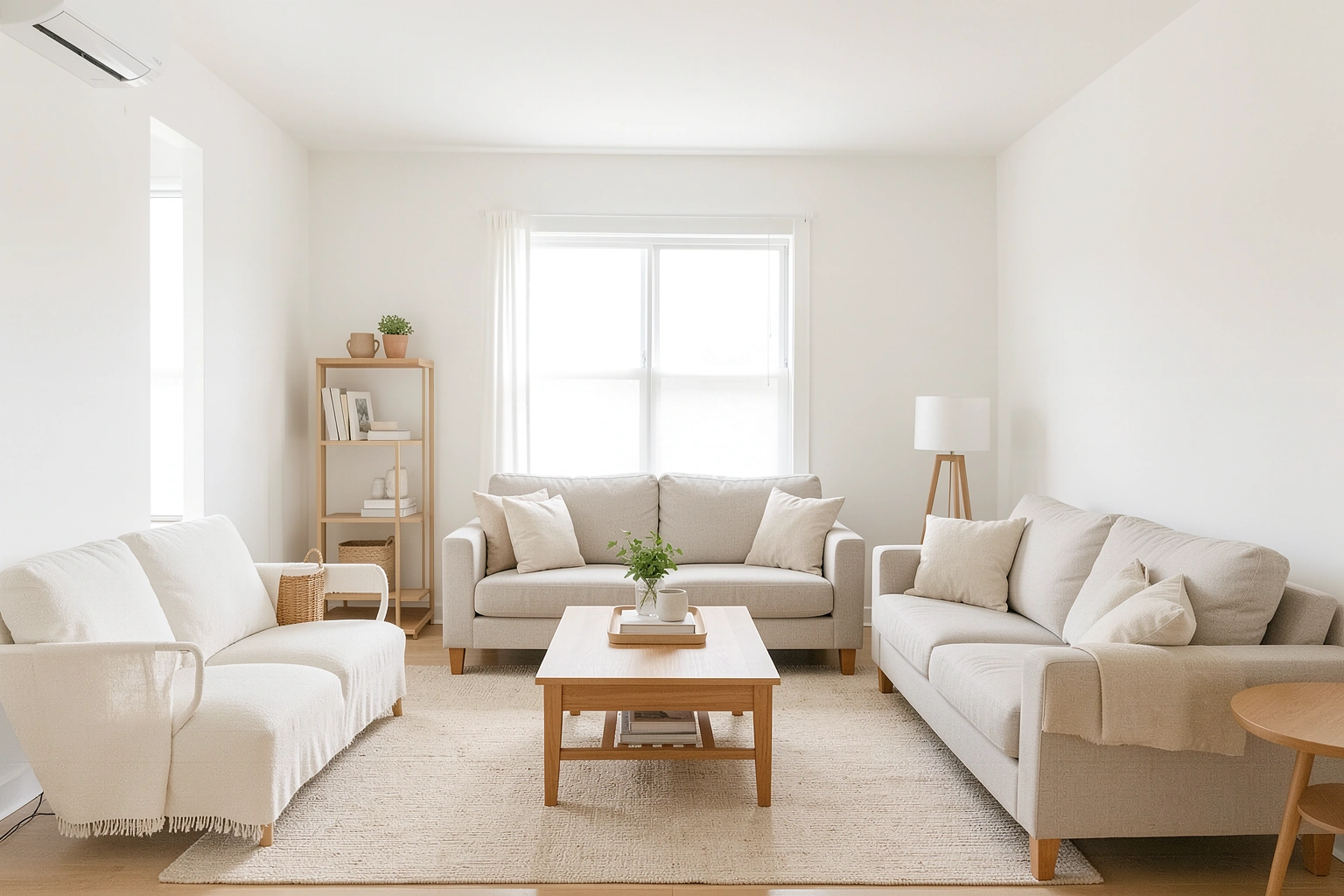
In compact rooms, that matters because every object is doing double duty: it has to look good and leave enough breathing room for daily life. When the room has too many things competing for attention, it can feel busier than it really is. When it has one clear lead element, the rest of the layout gets easier to solve.
What a focal point means in a small living room
A focal point is the feature that naturally draws attention first. In a living room, that might be a fireplace, a large window, a TV wall, a piece of art, or an accent wall. It is not always the same thing as the room’s functional center.
That distinction helps in small spaces. The functional center is where the room works best—for example, the open floor area you need to walk through, or the spot that allows the sofa and chairs to fit comfortably. The focal point is what the eye notices first.
Sometimes those two overlap. A fireplace wall may also be the best place for the sofa. In other rooms, they do not. A TV might be the practical anchor, while a window or artwork becomes the visual lead. Knowing the difference keeps you from forcing the furniture to revolve around the wrong thing.
Does a small living room need a focal point?
Usually, yes—at least one. A focal point gives the room a clear visual anchor so the layout feels more organized and easier to read.
But there is an important exception: if the room already has a strong natural anchor, you may not need to add anything extra. A fireplace, a large window, or a built-in media wall may already do the job. In that case, the smartest move is often to let that feature lead and keep everything else quiet.
Here is the simplest decision rule I use:
- Choose a focal point if the room feels blank, awkward, or visually scattered.
- Use the existing focal point if one feature already stands out clearly.
- Skip creating a new one if the room is already busy and adding another layer would make it feel tighter.
That last point matters more in small rooms than in larger ones. A tiny space can only hold so much visual weight before it starts to feel crowded.
Natural focal points versus created ones
Some focal points come built into the room. Others you create with furniture, art, color, or lighting. Both can work well in a small living room, but they solve different problems.
| Type | Best for | Trade-off |
|---|---|---|
| Fireplace | Rooms with a strong architectural feature | Can dominate a tiny wall if styling gets heavy |
| TV | Everyday family rooms and apartments | Practical, but can make the room feel very media-focused |
| Window | Rooms with good light or a view | Less control if the view is plain or the window placement is awkward |
| Statement art | Rentals and blank walls | Needs the right scale or it can look too small |
| Lighting | Softening a plain room | Usually works best as part of a larger focal area, not alone |
| Color feature | Subtle, low-commitment styling | Can disappear if the contrast is too weak |
A natural focal point is usually the easiest choice because it already belongs to the room. A created focal point is useful when the room lacks architecture or when the existing feature is not the one you want to emphasize.
If your room has a fireplace, for example, you can let it lead the layout and keep the rest of the wall simple. If the room has no architectural feature at all, a large framed print above the sofa can become the anchor without adding bulk.
Should the TV be the focal point?
Often, yes—but not automatically.
In a small living room, the TV is frequently the most practical anchor because it defines where seating goes and how people face the room. If you use the room for movies, gaming, or everyday family time, the TV may be the most functional focal point available.
The trade-off is visual weight. A TV wall can feel heavy if it is surrounded by too much shelving, too many decorative objects, or a dark console that swallows the wall. The goal is to make the TV read as intentional, not like the room stopped halfway through styling.
A good TV setup in a small room usually looks calmer when the surrounding decor is restrained:
- one console or low cabinet
- a simple art arrangement or none at all
- minimal objects on nearby surfaces
- clean lines around the screen
If you want a deeper placement guide, I also wrote a separate layout post on where to place a TV in a small living room.
How to create a focal point without crowding the room
The best small-room focal points are not loud. They are clear.
Think in terms of hierarchy. One feature should lead, and everything else should support it. That can be done with scale, contrast, framing, and restraint.
1. Pick one feature to lead
If the room already has a fireplace, choose it. If not, choose one visual anchor: the TV wall, a window, or one large piece of art. Do not give every wall equal importance.
That is where small rooms go sideways. When the sofa, coffee table, shelves, plants, and wall decor all compete for attention, the eye has nowhere to rest.
2. Match the scale to the wall
A focal point should feel proportionate to the wall and the furniture around it. In a small room, that means choosing something that feels substantial enough to read clearly, but not so large that it swallows the wall.
For example, a single oversized print above a sofa usually works better than three tiny frames scattered across the wall. A low media console can anchor a TV better than a tall, bulky cabinet that crowds the screen. And a slim accent wall treatment can add definition without making the room feel boxed in.
If the focal point is too small, it looks accidental. If it is too large, it can crowd the room visually.
3. Use contrast carefully
Contrast helps the focal point stand out, but too much contrast can make the room feel chopped up. A dark TV on a dark wall can disappear. A bright white frame on a plain wall may feel too thin. The sweet spot is enough difference to register, not so much that the wall becomes the only thing you notice.
A practical way to use contrast in a tiny room is to limit it to one area. For example, pair a light sofa with a darker art piece above it, or use a textured rug to ground a simple seating area while keeping the surrounding walls quiet.
4. Frame the focal point with simpler pieces
A focal point does not need a crowd. A pair of matching lamps, a rug that grounds the seating area, or a single bench under a window can help guide the eye without adding clutter.
If you have both a TV and a fireplace in a small room, choose the one that fits the room’s main use. For example, if the room is mostly for movie nights, let the TV lead and keep the fireplace styling minimal. If you mostly read or talk in the room, let the fireplace lead and place the seating to face it, with the TV kept quieter on a side wall if possible.
5. Leave some blank space
This is the part many people skip. Negative space is what lets the focal point breathe. In a small living room, blank wall area is not wasted space; it is visual relief.
A few inches of empty wall around art, a clear stretch of floor near the entry path, or an uncluttered console top can make the whole room feel calmer. The goal is not to fill every surface. It is to make the focal point feel deliberate.
How to arrange furniture around the focal point
Once the focal point is chosen, the furniture should support it without blocking circulation.
The sofa usually sets the direction first. In a small room, it often makes sense to place the main seating piece facing the focal point or angled toward it. Chairs can then complete the conversation area without closing off the room.
A few practical rules help here:
- Keep the main walking path open between the entry and the rest of the room.
- Orient the main seating toward the focal point so the room has a clear direction.
- Let the rug define the seating zone so the furniture feels grouped, not floating.
- Avoid pushing every piece against the walls if that creates a wide empty center and awkward traffic.
- Use smaller-scale pieces when the room is tight, especially side tables and accent chairs.
If the focal point is on the shortest wall, that often helps a narrow living room feel more balanced because it gives the furniture a clear destination without stealing walkway space. If you need a more detailed walk-through on seating placement, my guide to arranging furniture in a small living room goes deeper into spacing and flow.
Realistic layout examples for small living rooms
A small room with a fireplace
Let the fireplace lead. Place the sofa facing it if the room width allows, then use a rug to define the seating area. Keep the mantel styling simple so the fireplace stays the clear anchor.
If the fireplace is off-center, resist the urge to “balance” it with too many accessories. Instead, use one or two symmetrical pieces and let the asymmetry be part of the room’s character.
A compact apartment with a TV wall
Mounting or centering the TV on one wall often creates the clearest focal point in a small apartment. Keep the console low and visually quiet. If possible, avoid filling the entire wall with shelving around the screen unless storage is truly needed.
This works best when the seating faces the screen and the walkway stays behind or beside the seating area.
A room with a good window view
If the window has light, a tree view, or an interesting architectural frame, it can become the focal point. Angle a chair toward it or place the sofa so the window is visible from the main seating spot.
If the view is not especially strong, the window may still serve as a secondary anchor while art or a lamp becomes the lead feature.
A narrow living room with no obvious feature
Choose the shortest wall for the focal point. That could be a large art piece, a low media console, or a simple accent color behind the sofa. This helps the room feel less tunnel-like and gives the layout a natural end point.
A rental living room with blank walls
Use what you can change without permanence: a large framed print, a tall lamp, a rug that defines the seating area, and one or two coordinated pillows or throws. The room does not need built-ins to feel finished.
Common mistakes that make a small living room feel busier
The biggest mistake is trying to give the room more than one “main” feature.
A fireplace, a TV, an accent wall, and a gallery wall can all exist in the same room, but they should not all compete for lead status. One should be primary. The others should step back.
Other common problems:
- Oversized decor that eats wall space
- Too many small objects spread across every surface
- A rug that is too tiny to connect the seating group
- Furniture blocking the focal point so it cannot be seen from the main seat
- Strong patterns on every wall when the room already has limited visual space
That is exactly what small rooms tend to do when every surface is treated like a display area. The fix is not more decor. It is clearer hierarchy.
What to do if the room still feels off
If the focal point is in place but the room still feels awkward, check these three things.
The focal point may be too weak
If the feature does not stand out, strengthen it with scale or contrast. A larger piece of art, a more defined lamp pair, or a darker console can help. The goal is not drama for its own sake—it is clarity.
The room may have competing anchors
Look for other attention-grabbing elements and simplify them. If the TV is the focal point, tone down the mantel decor. If the window is the anchor, reduce the wall art nearby. One lead feature is easier to read than several equal ones.
The layout may be fighting the room flow
Sometimes the problem is not the focal point at all. The sofa may be interrupting the walkway. A chair may be blocking the view. Or the rug may be too small to visually connect the seating.
When that happens, fix circulation first. A room that is easy to move through usually feels calmer immediately.
Rent-friendly ways to create a focal point
Renters have more options than they think.
You can create a focal point without paint, built-ins, or permanent mounting by using:
- a large framed artwork leaning or hung with removable hardware
- a floor lamp that visually “marks” one side of the room
- a rug that defines the seating zone
- a console table or media stand with clean lines
- layered textiles in one color family
- a mirror that reflects light and gives the wall more presence
The key is to keep the arrangement simple enough that the focal area reads as one idea, not a collection of separate decor decisions.
A blank rental wall can actually be an advantage. Without a fireplace, you have a blank slate to create something that reflects your personality. In a small room, that freedom is useful as long as you keep the design restrained.
When to consult a space planner
If your small living room has multiple doors, an awkward corner fireplace, a large TV, and not much wall space, a space planner can help you sort out the hierarchy before you buy furniture or drill holes.
That is especially worth considering when:
- circulation feels blocked no matter how you arrange the room
- the TV and fireplace both compete for attention
- the room has an unusual shape
- you are trying to fit both storage and seating into one tight layout
A professional can help you decide what should lead visually and what should support the room functionally, which saves a lot of trial and error.
FAQs
Can a small living room have more than one focal point?
Yes, but one should still be primary. Think of the others as supporting features. A TV and a window can coexist, for example, as long as one is clearly the lead and the other stays quieter.
What is the best focal point if my room has no fireplace?
Choose the feature that best supports how you use the room. For many small living rooms, that is the TV wall or one large piece of art. If the room has great natural light, the window may be the better anchor.
Should the TV always be the focal point in a small living room?
No. It is often the most practical choice, but not always the most visually pleasing one. If the room is mainly for conversation or reading, a fireplace, window, or art wall may work better.
How do I keep a focal point from overwhelming a tiny room?
Use one lead feature, keep surrounding decor minimal, and match the focal point to the wall size. A small room usually looks better with a clear but restrained anchor than with a dramatic feature that takes over the whole wall.
What if my room already feels too busy?
Simplify the secondary elements first. Remove extra decor from shelves, reduce competing wall pieces, and choose one clear visual lead. In a small room, reducing noise is often more effective than adding new decor.
A small living room does best when it knows what it wants to be seen as first. Once that decision is clear, the furniture, lighting, and decor can finally work together instead of competing for attention.