
Where Should an Accent Chair Go in a Small Living Room? A Practical Layout Guide

A small living room can handle an accent chair beautifully — but only if the chair has a job and a clear place to belong. The best spot is usually the one that supports the room’s main flow: beside the sofa, angled toward the focal point, tucked into a usable corner, or placed by a window if that light-filled spot can function as a reading nook.
If you want the shortest version of the rule, use this: place the chair where it helps seating, balances the room, and does not interrupt the path people naturally take through it. In a tiny room, that often means choosing one strong placement rather than squeezing the chair into the leftover space.
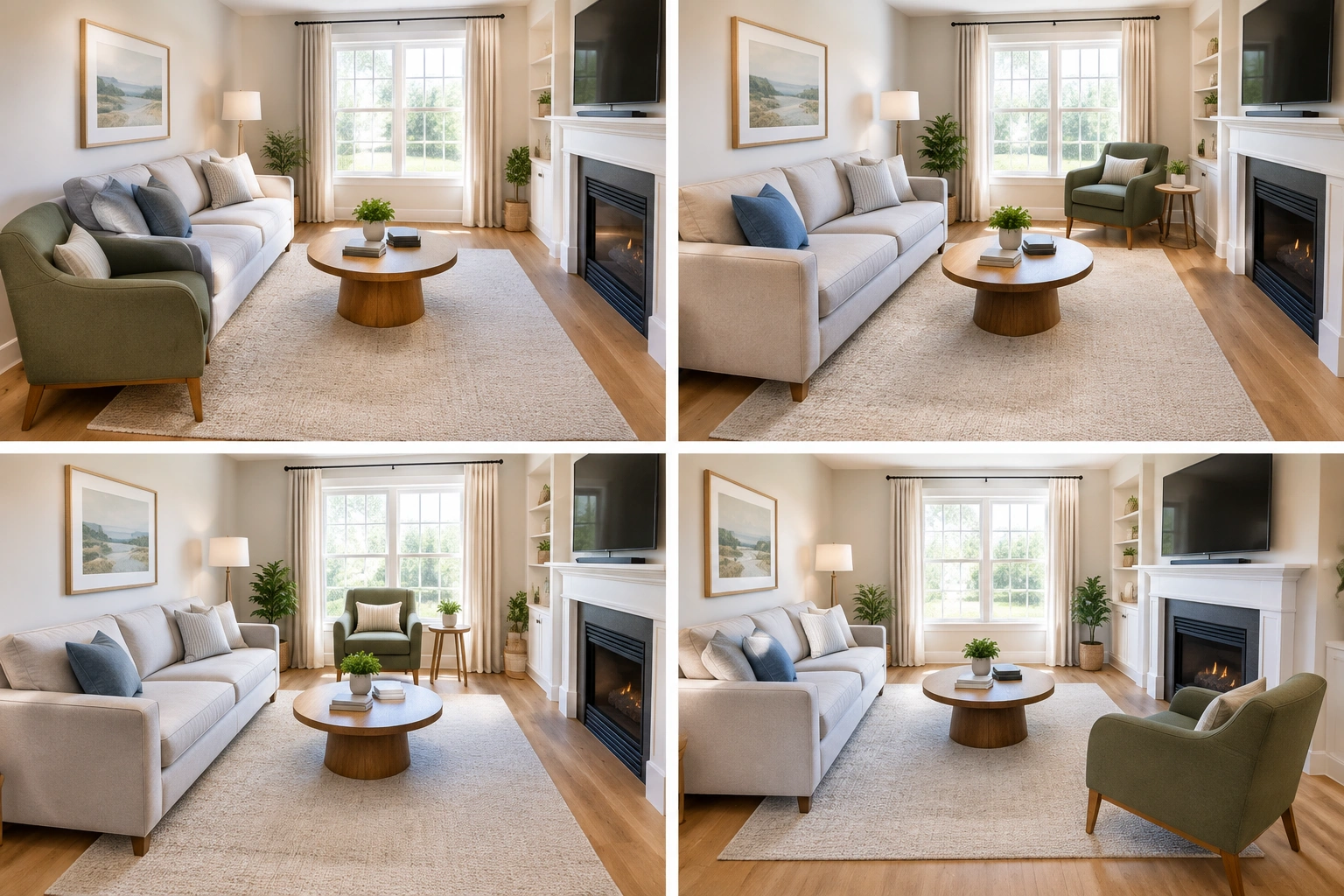
Quick Answer: The Best Places for an Accent Chair
In a small living room, the most effective accent chair placement usually falls into one of four spots:
- Beside the sofa if you want a conversation area
- In a corner if you need to use dead space
- By a window if the chair will become a reading seat
- Angled toward the room’s focal point if the layout needs balance
The best choice depends on what the chair is supposed to do. If it is mainly extra seating, keep it close to the sofa. If it is more of a visual anchor, a corner or window can work better. If the room feels awkward, a slight angle can help the chair feel intentional instead of shoved in.
A useful mental test: if you can point to the chair and explain why it is there, the placement is probably working. If it looks like it landed there by accident, move it.
What to Check Before You Place the Chair
Before you decide on a spot, look at the room as a fixed puzzle. Doors, windows, radiators, vents, TV placement, and fireplace location all limit where the chair can go. In a small room, those fixed elements matter more than style preferences because one bad placement can throw off the whole flow.
Ask these questions first:
-
Where do people enter and cross the room?
That path needs to stay open. -
What is the room’s main focal point?
It might be a TV, fireplace, window, or the sofa itself. -
Will the chair be used daily or only when guests visit?
A regular reading chair needs a more comfortable, accessible spot than a backup seat. -
Are there obstacles like curtains, vents, or radiator heat?
Those areas should stay usable and unobstructed. -
Does the room already feel full?
If the sofa and coffee table already dominate the space, the chair needs a lighter footprint.
This is also where scale starts to matter. A chair that looks beautiful in a showroom can still overwhelm a small room if it has a bulky frame, deep seat, or heavy arms. In compact rooms, the chair should behave like part of the layout — not like a separate furniture event.
How Much Space to Leave Around an Accent Chair
There is no universal number that works for every small living room, but there are practical spacing rules that help. The goal is simple: make the chair easy to use without forcing people to squeeze around it.
A good place to begin is to leave enough room for:
- A clear walkway beside or in front of the chair
- A small gap if you add a side table
- Enough breathing room so the chair does not touch nearby furniture
If the chair is part of a seating group, it should feel connected to the sofa rather than isolated. If it is a reading chair, it needs enough open space around it to reach a lamp, side table, or ottoman without crowding the rest of the room.
Here are simple rules of thumb you can use right away:
- Walkway clearance: aim for about 30 to 36 inches where people need to pass regularly. In a very tight room, you may be able to live with less, but once the path starts feeling squeezed, the layout usually needs to change.
- Chair-to-sofa spacing: keep the chair about 24 to 36 inches from the sofa if you want it to feel connected and still leave room to move between them. Closer than that can feel cramped; much farther can make the chair seem detached.
- Side-table placement: leave about 2 to 4 inches between the chair and a side table if they are meant to sit together. The table should be within easy reach, but not so close that it crowds the seat or blocks an arm.
A practical way to judge the layout is to stand up and walk the route people will actually use. If the chair makes that route awkward or narrow, it probably needs to move closer to a wall, into a corner, or farther into the seating zone where it can belong more naturally.
A side table is helpful only when it still leaves the chair easy to approach. In a small room, a table that is too deep or too wide can create more clutter than convenience.
Step-by-Step: Where to Put the Chair
Think of placement as a short sequence instead of a guessing game.
1. Identify the room’s anchor
Start with the strongest fixed feature: TV, fireplace, window, or the sofa arrangement itself. The chair should relate to that anchor, not compete with it. In a small room, furniture that ignores the anchor usually looks scattered.
2. Decide the chair’s purpose
Choose one purpose before you place it:
- Extra seating
- Reading spot
- Visual accent
- Conversation partner for the sofa
That purpose determines the best location. A reading chair wants light and a side surface. A conversation chair wants proximity to the sofa. A visual accent can live in a corner if it still feels connected to the room.
3. Test the traffic path
Walk the room in your mind from doorway to sofa, TV, or hallway. The chair should stay out of the main route. In a small room, even a stylish chair becomes a problem if it blocks the easiest path across the space.
4. Place the chair in relation to the sofa
Most small living rooms work best when the chair has a visible relationship to the sofa. That can mean beside it, slightly across from it, or angled toward it. The layout should feel like a conversation zone, not a waiting room.
5. Adjust for balance
If one side of the room feels visually heavy, the chair can offset it. A chair near a window, in a corner, or opposite a sofa arm may help the room feel more even. The key is to make the chair relate to something else in the room so it does not look stranded.
Best Accent Chair Placements by Room Layout
Narrow living room
In a narrow room, the best chair placement is usually along the side of the sofa, or in a back corner if that keeps the main walkway open. A chair placed straight across from the sofa can make the room feel tighter if the aisle is already limited.
A diagonal angle can work well in narrow layouts because it softens the boxy shape and uses corner space without creating a hard barrier.
Square living room
Square rooms can handle a more conversational layout. A chair beside the sofa or slightly across from it often works well because the proportions are more forgiving. This is also the kind of room where a small side table can fit without making circulation feel cramped.
If the room has a central rug and coffee table, the chair should help complete the grouping rather than sit too far away from it.
Awkward corner or dead space
A lonely corner can become useful space if the chair gives it a purpose. This is one of the best renter-friendly solutions because it uses space that would otherwise be empty without requiring a larger rearrangement.
A corner chair works best when it is not shoved tightly into both walls. Pull it out enough to create a small vignette, then keep the styling simple. A table, lamp, or throw is usually enough.
Room with a window
A window seat works especially well when the chair will be used for reading or quiet time. Natural light makes the chair feel intentional, and the placement can keep the room from feeling overfurnished.
Just make sure the chair does not block curtains, radiator access, or window operation. If the window already has a strong presence, keep the chair visually light so the area feels open rather than crowded.
Beside the Sofa, in a Corner, or by a Window?
This is the decision most people get stuck on, so here is the trade-off in plain language.
| Placement | Best for | Trade-off | Best when… |
|---|---|---|---|
| Beside the sofa | Conversation, added seating, a cohesive layout | Can narrow the walkway | You want the chair to feel connected to the main seating group |
| In a corner | Using dead space, visual balance, renter-friendly layouts | Can feel disconnected if placed too far away | The room has an awkward corner that needs a purpose and you do not want to crowd the center |
| By a window | Reading nook, natural light, softer visual effect | May interfere with curtains or access | The chair can sit near light without blocking the window and the room needs a quieter zone |
| Angled toward a focal point | Flexible seating, better flow, a more relaxed look | Needs careful positioning to avoid looking random | The room needs help feeling intentional but does not have room for a full face-to-face grouping |
If you want the chair to act like part of the conversation area, place it near the sofa. If you want it to disappear a bit and free up the center of the room, a corner or window spot may be better.
How to Choose the Right Chair Size and Style
In a small living room, size matters as much as placement. A compact chair usually works better than an oversized one because it preserves both physical clearance and visual openness.
For very small rooms, look for a chair that stays visually light and does not dominate the floor plan. Two especially workable options are:
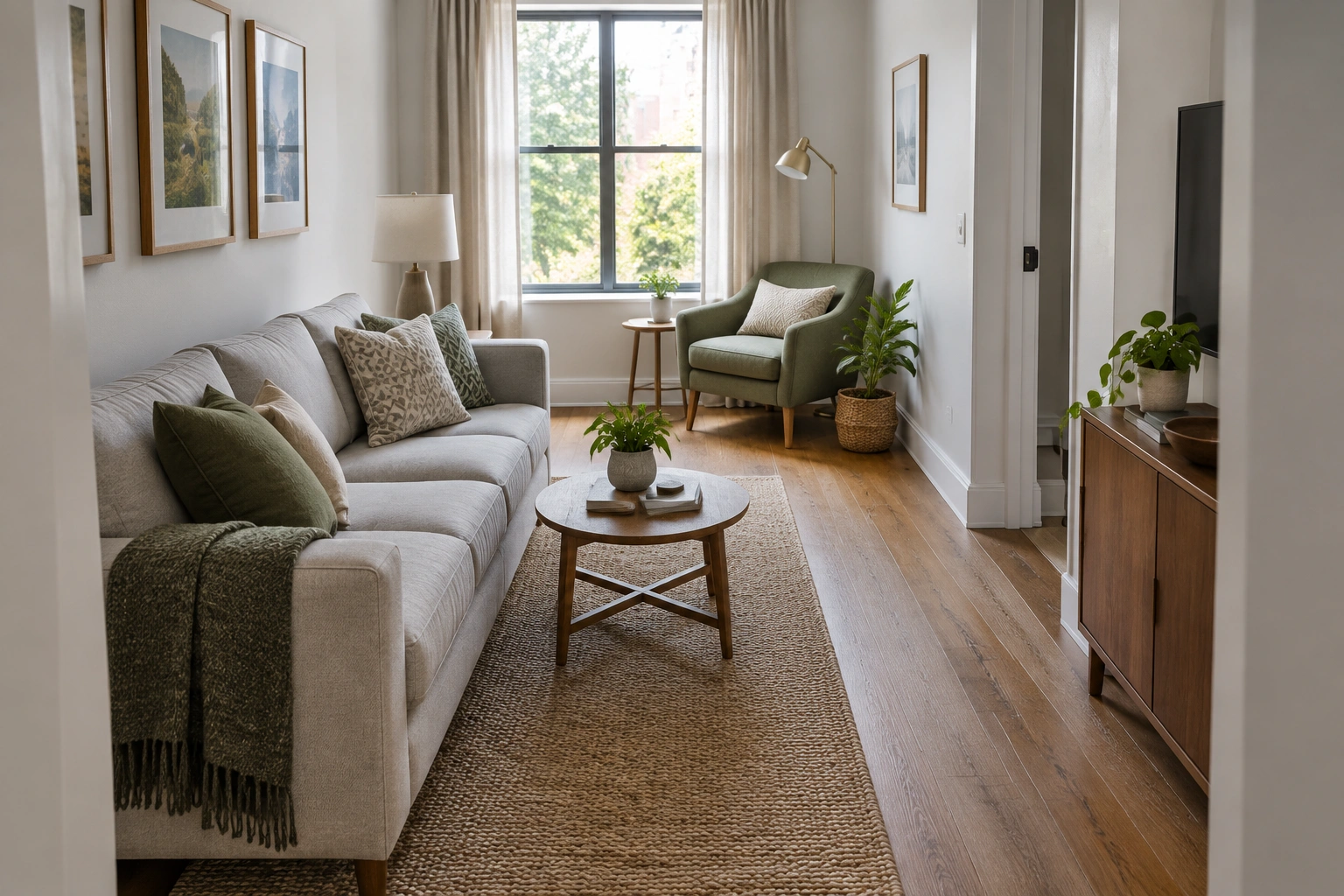
- An armless or slim-armed chair with a narrow silhouette, which is easier to tuck beside a sofa or into a corner
- A low-profile chair with open legs and a footprint that is roughly in the 28 to 32 inch wide range, or otherwise scaled so it does not overwhelm the seating area
A chair with arms can still work, but it tends to feel bulkier, so it is usually better when the room has a little more breathing room. An armless chair is often the safer choice when circulation is tight. A compact swivel chair can also work in a multipurpose room, though it needs enough surrounding space to turn comfortably.
If the chair is mainly decorative, choose the lighter-looking option. If it is meant for daily use, comfort matters more — but even then, the frame should still suit the room’s scale.
One Accent Chair or Two?
In a small living room, one chair is often enough. That is especially true if the sofa already handles most of the seating. A single chair can add function without making the room feel crowded.
Two chairs can work when the room has enough width to support them, or when they are doing a specific job such as framing a fireplace or creating a conversation area across from the sofa. A pair can make the room feel more complete and inviting, but only if the room can hold the symmetry without losing circulation.
Use this simple filter:
- Choose one chair if the room is tight, the sofa is large, or the chair is mainly an accent.
- Choose two chairs if the room has enough space to support a balanced grouping and the chairs are part of the main seating plan.
If you are unsure, begin with one. It is easier to add a second chair later than to recover from a room that feels overfilled.
How to Place an Accent Chair with a Sofa, TV, or Fireplace
The chair should relate to the room’s main feature.
With a sofa
The chair can sit beside the sofa, slightly angled toward it, or across from one end if the room allows. This creates a conversation zone and keeps the layout feeling connected. If the chair is too far away, it starts to look like leftover furniture.
With a TV
A TV-centered room usually works best when the chair can join the same viewing zone as the sofa without forcing a rigid, face-to-face setup. In a small room, that often means placing the chair slightly off the main TV axis so it still feels usable without blocking the screen or the path to the sofa. If the TV is the room’s main focal point, the chair should support that sightline first and the conversation layout second.
For more TV-specific layout ideas, you can also see where to place a TV in a small living room.
With a fireplace
A fireplace gives the chair a natural destination. A single chair can angle toward the hearth, or two chairs can help frame it if the room is large enough to handle the symmetry. In a small room, the chair should support the fireplace view without crowding the sofa.
If the fireplace and sofa both compete for attention, choose the one that functions as the room’s primary anchor and let the chair relate to that feature first. If the fireplace is decorative but the TV is used more often, the chair usually needs to work with the TV zone rather than the mantel.
If you are still deciding on the room’s anchor, this guide on whether a small living room should have a focal point can help you choose the best one before you place anything else.
Common Mistakes That Make the Room Feel Cramped
The most common layout problems are usually not about style — they are about placement.
Avoid these mistakes:
- Blocking the main walkway
- Choosing a chair that is too deep or too wide
- Pushing the chair so far away that it feels unrelated
- Adding a side table that steals circulation
- Filling every corner just because it is empty
- Ignoring doors, windows, or heat sources
- Using two chairs when one would fit better
A small room needs a little restraint. Empty space is not wasted space; it is what lets the furniture feel deliberate.
Troubleshooting Awkward Small-Room Layouts
If the chair feels wrong, the fix is often small.
- If the path feels tight: move the chair closer to the wall or angle it slightly
- If the chair feels lonely: bring it closer to the sofa or add a small table nearby
- If the room feels crowded: remove the side table first, then reassess
- If the corner looks empty but useful: place the chair diagonally and keep the styling minimal
- If the window area feels blocked: shift the chair away from the curtain line and keep the profile lower
In a renter-friendly room, this kind of adjustment is especially helpful because you can improve the layout without changing anything structural.
Practical Layout Examples
Narrow apartment living room
Place the accent chair diagonally in a back corner or beside the sofa, depending on which choice preserves the main walkway. This keeps the center of the room open and avoids creating a bottleneck near the entry.
Small square living room with a sofa
Put the chair beside the sofa with a slim side table between them if there is room. That creates a compact conversation zone without requiring a full second seating group.
Window nook layout
Use the chair as a reading spot near the window, then add a lamp only if it does not crowd the curtain line. This works especially well when the rest of the room already feels busy and needs one quieter corner.
TV-centered layout
Angle the chair slightly inward so it can face both the sofa and the screen. This keeps the room flexible for guests while still making the chair feel connected to the rest of the seating.
When to Consult a Space Planner
If your small living room has multiple fixed obstacles — such as a fireplace, radiator, two doors, and a TV wall all competing for space — a space planner can help you test layout options before you commit. That can be especially useful if the room has to function as both everyday seating and guest seating.
Final Take
In a small living room, the best place for an accent chair is usually the one that supports the room’s flow and gives the chair a clear purpose. If you keep the chair connected to the sofa, respectful of the walkway, and sized to the room, it will feel like part of the plan instead of an afterthought. The smallest rooms often look best when every piece earns its place.
FAQ
How far should an accent chair be from the sofa in a small living room?
A practical starting point is about 24 to 36 inches. That usually keeps the chair connected to the seating group while leaving enough room to move between the pieces.
Is it better to put an accent chair in a corner or beside the sofa?
If the chair is mainly for conversation or extra seating, beside the sofa is usually the better default. If the room has an awkward unused corner, the corner is often the better choice because it uses dead space without crowding the center.
Should an accent chair match the sofa?
It does not have to match exactly. In a small living room, the chair often works best when it complements the sofa through shape, scale, or color rather than copying it. A little contrast can help the chair feel intentional, as long as the room still looks balanced.
Is an armless chair better than a chair with arms in a small room?
Often, yes. An armless or slim-armed chair usually takes up less visual and physical space, so it can be easier to place in a tight room. A chair with arms can still work if the room has enough clearance.
Is one accent chair enough in a very small living room?
Usually, yes. One chair is often the best choice when the sofa already provides most of the seating or when circulation is tight. A second chair makes more sense only if the room can handle the extra footprint without feeling crowded.
Can I place an accent chair by a window?
Yes, if the chair will not block the curtain line, window operation, or radiator access. A window spot is often a strong choice when you want a reading nook or a lighter-feeling corner.
How do I know if the chair is too big for the room?
If it narrows the walkway, crowds the sofa, or makes the room feel visually heavy, it is probably too large for the space. In a small living room, a lighter silhouette and a smaller footprint usually work better.
What if the TV and fireplace both feel like focal points?
Pick the feature that the room uses most often as the main anchor, then place the chair to support that zone first. If both are important, keep the chair flexible and avoid locking it into a position that blocks either sightline.